Search the Site with 
General Characteristics Crew List Memorabilia Cruise Books History Homeports of USS Claude V. Ricketts Patch Gallery Image Gallery to end of page
USS Claude V. Ricketts (DDG 5)

- formerly DD 955 -
- formerly BIDDLE -
- decommissioned -


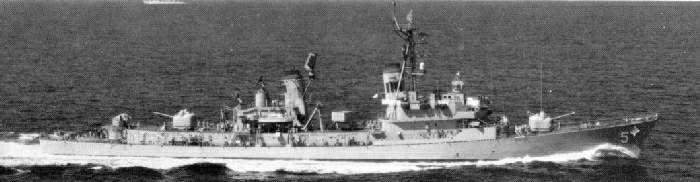
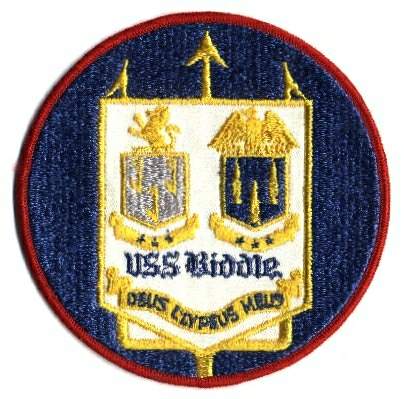
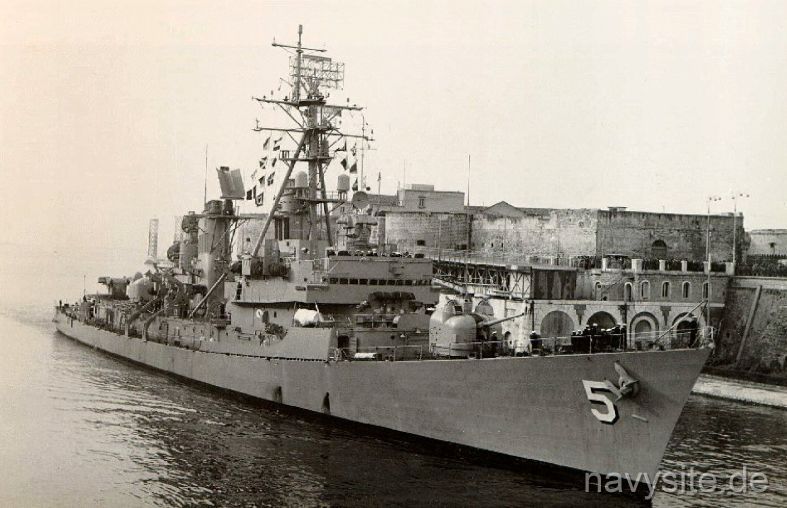
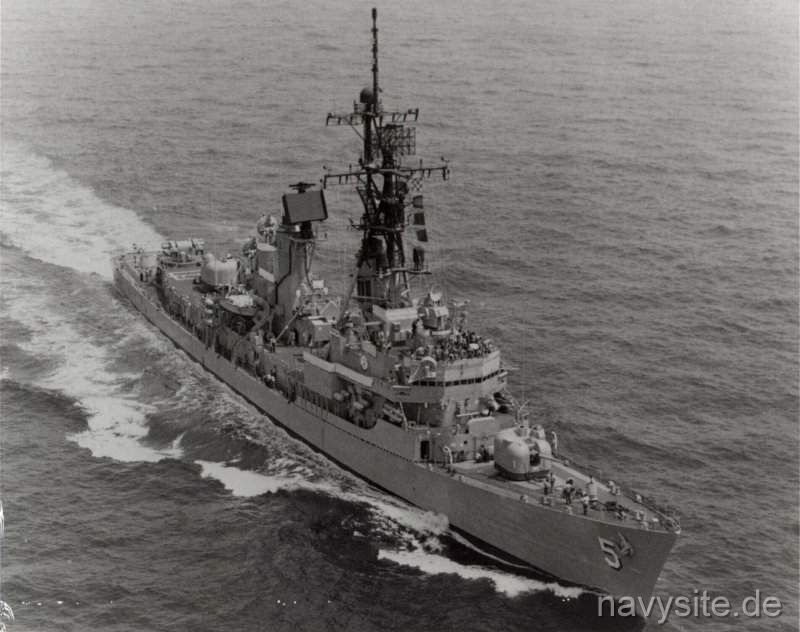
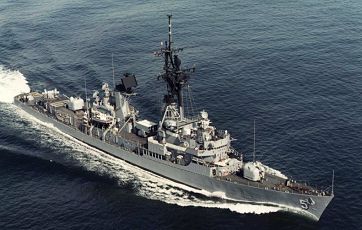
USS CLAUDE V. RICKETTS was the 4th ship in the CHARLES F. ADAMS - class of guided missile destroyers and last was homeported in Norfolk, Va. Originally, the ship was named BIDDLE but was renamed on July 28, 1964. Decommissioned on October 31, 1989, and stricken from the Navy list on June 1, 1990, the ship was later sold for scrapping.

General Characteristics:Keel laid: May 18, 1959
Launched: June 4, 1960
Commissioned: May 5, 1962
Decommissioned: October 31, 1989
Builder: New York Shipbuilding Corp., Camden, N.J.
Propulsion system:4 - 1200 psi boilers; 2 geared turbines
Propellers: two
Length: 437 feet (133.2 meters)
Beam: 47 feet (14.3 meters)
Draft: 20 feet (6.1 meters)
Displacement: approx. 4,500 tons
Speed: 31+ knots
Aircraft:none
Armament: two Mk 42 5-inch/54 caliber guns, Mk 46 torpedoes from two Mk-32 triple mounts, one Mk 16 ASROC Missile Launcher, one Mk 11 Mod.0 Missile Launcher for Standard (MR) and Harpoon Missiles
Crew: 24 officers and 330 enlisted


Back to topback to top  go to endgo to the end of the page


Back to topback to top  go to endgo to the end of the page

Crew List:

This section contains the names of sailors who served aboard USS CLAUDE V. RICKETTS. It is no official listing but contains the names of sailors who submitted their information.


back to top  go to the end of the page


Back to topback to top  go to endgo to the end of the page

USS CLAUDE V. RICKETTS Cruise Books:


Back to topback to top  go to endgo to the end of the page


Back to topback to top  go to endgo to the end of the page

USS CLAUDE V. RICKETTS History:

USS CLAUDE V. RICKETTS - originally commissioned as USS BIDDLE - was a CHARLES F. ADAMS-class guided-missile destroyer built by New York Shipbuilding, Camden, New Jersey. Her keel was laid on May 18, 1959; she was launched on June 4, 1960; and she commissioned as USS BIDDLE at Philadelphia on May 5, 1962, joining the Atlantic Fleet with Norfolk, Virginia, as homeport. In her first year she operated in the western Atlantic and Caribbean with Second Fleet, a period that included heightened operations near Cuba in the weeks before the Cuban Missile Crisis. The Navy later credited the ship for expeditionary service during August-September 1962.

Through 1963, BIDDLE continued Atlantic readiness workups and then made her first Mediterranean deployment late in the year, returning to Norfolk in March 1964. On July 28, 1964 - three weeks after the death of the Vice Chief of Naval Operations - the Navy renamed the destroyer USS CLAUDE V. RICKETTS to honor Admiral Claude V. Ricketts. The ship immediately moved into a high-profile multinational "mixed-manning" demonstration, sailing with a crew of U.S. officers and sailors integrated with contingents from West Germany, Italy, Greece, the United Kingdom, the Netherlands, and Turkey to evaluate concepts for a proposed NATO Multilateral Force. Over roughly June 1964-December 1965 she steamed extensively with allied units and visited ports reflecting the participating nations. The Navy deemed the test successful and later awarded a Navy Unit Commendation for the period.

From 1966 into 1973, CLAUDE V. RICKETTS settled into a steady rhythm of Sixth Fleet deployments as the U.S. posture in Europe evolved after the France-NATO split and as crises flared in the eastern Mediterranean. Cruise books document Mediterranean deployments in 1969 and 1971, and Navy archival notes record a Northern Europe cruise in July 1972 that included operations with allied navies and high-latitude exercises before she returned to Norfolk for stateside training. In August 1973, she again deployed to the Mediterranean and came home in January 1974, then entered Norfolk Naval Shipyard for a ten-month overhaul that ran through January 1975, followed by refresher training and trials in the Caribbean in March-May 1975.

In mid-1975 the destroyer sailed once more for Sixth Fleet. On November 22, 1975, operating at night off Sicily, guided-missile cruiser USS BELKNAP (CG 26) collided with aircraft carrier USS JOHN F. KENNEDY (CV 67) and caught fire. CLAUDE V. RICKETTS closed, went alongside BELKNAP's port side under exploding small-caliber ammunition, and fought the blaze for hours while evacuating injured sailors. Destroyer USS BORDELON (DD 881) also came alongside to assist. The ship's actions were later singled out in official histories and Proceedings accounts. The crew received a Navy Unit Commendation. CLAUDE V. RICKETTS returned to Norfolk in January 1976.

On October 4, 1976, she deployed again to the Mediterranean and, as part of a broader U.S. Navy tasking to demonstrate support for East Africa, proceeded into the Indian Ocean. In December 1976, she arrived at Mombasa, Kenya, in company with amphibious assault ship USS GUAM (LPH 9) and destroyer USS DU PONT (DD 941) in recognition of the 13th anniversary of Kenyan independence, a port phase documented by contemporary Navy reporting and press. After returning to Norfolk, she deployed again within weeks for a six-week operation with the Brazilian Navy, then entered a major overhaul at Philadelphia Naval Shipyard from September 1977 to October 1978, completing refresher training and returning to Norfolk in April 1979.

In September 1979, the destroyer began a seven-month cruise split between the Middle East Force and Sixth Fleet at a time of rising tension in the Persian Gulf. When the Iran hostage crisis erupted on November 4, 1979, CLAUDE V. RICKETTS shifted promptly to Persian Gulf tasking in company with command ship USS LA SALLE (AGF 3) and remained largely at sea for weeks on end as U.S. forces established a persistent presence. She returned to the Mediterranean in February 1980 and reached Norfolk in April 1980. The Navy later credited the ship for expeditionary service connected to the crisis.

From January to June 1981 CLAUDE V. RICKETTS served with NATO's Standing Naval Force Atlantic (STANAVFORLANT), a high-tempo multinational flotilla that carried her from Gibraltar to the Norwegian Sea and west to Halifax. Official imagery places her off Norway in April-May 1981. For the deployment the ship received a Meritorious Unit Commendation, and a second MUC recognized follow-on operations later in 1981.

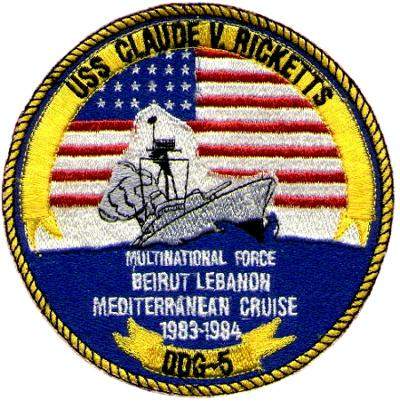
The destroyer's next notable overseas duty came in the aftermath of the October 1983 Beirut barracks bombing, when she deployed to the Eastern Mediterranean in late 1983 and early 1984 to support U.S. operations off Lebanon, a period reflected in Armed Forces Expeditionary Medal credit for three time windows spanning November 1983 to February 1984. She continued Atlantic readiness into the latter 1980s and made a final Mediterranean deployment in late 1987, returning to Norfolk on March 29, 1988.

After more than twenty-seven years in commission, CLAUDE V. RICKETTS decommissioned at Norfolk on October 31, 1989, and was stricken from the Naval Vessel Register on June 1, 1990. The hull entered disposal proceedings in the 1990s. A 1994 sale for scrapping was later terminated and the Navy repossessed the ship in October 1996 before reselling her in December 2001. Scrapping was completed on November 8, 2002, closing the record of a Norfolk-based ADAMS-class destroyer that had moved from Cold War Mediterranean patrols and a landmark NATO mixed-manning demonstration through crisis response in the Persian Gulf and multinational operations with STANAVFORLANT and Sixth Fleet.


Back to topback to top  go to endgo to the end of the page

Homeports of USS CLAUDE V. RICKETTS:

PeriodHomeport
commissioned at Philadelphia, Penn.
1962 - 1989Norfolk, Va.


Back to topback to top  go to endgo to the end of the page

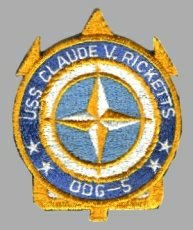
USS CLAUDE V. RICKETTS Patch Gallery


Back to topback to top  go to endgo to the end of the page


Back to topback to top


Back to Destroyer list. Back to ships list. Back to selection page. Back to 1st page.