![]() |
Search the Site with
|
![]() | ![]() | ![]() |
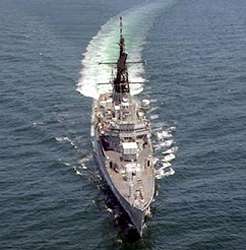
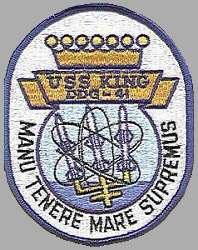
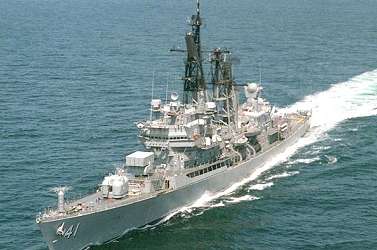
USS KING was the fifth ship in the FARRAGUT - class of guided missile ships. Commissioned as a guided missile frigate (DLG), the USS KING was reclassified as guided missile destroyer (DDG) on June 30, 1975, changing its hullnumber from DLG 10 to DDG 41. In 1973, the ship served as the test platform for the prototype of the newly developed Phalanx CIWS.
Decommissioned on March 28, 1991, and stricken from the Navy list on November 20, 1992, the USS KING was sold for scrapping on April 15, 1994. The ship was last homeported in Norfolk, Va.
| General Characteristics: | Awarded: November 18, 1955 |
| Keel laid: March 1, 1957 | |
| Launched: December 6, 1958 | |
| Commissioned: November 17, 1960 | |
| Decommissioned: March 28, 1991 | |
| Builder: Puget Sound Naval Shipyard, Bremerton, Wash. | |
| Propulsion system:4 - 1200 psi boilers; 2 geared turbines | |
| Propellers: two | |
| Length: 512.5 feet (156.2 meters) | |
| Beam: 52 feet (15.9 meters) | |
| Draft: 25 feet (7.6 meters) | |
| Displacement: approx. 5,800 tons | |
| Speed: 33 knots | |
| Aircraft:none | |
| Armament: one Mk 42 5-inch/54 caliber gun, | |
| Crew: 21 officers and 356 enlisted |
Crew List:
This section contains the names of sailors who served aboard USS KING. It is no official listing but contains the names of sailors who submitted their information.
USS KING Cruise Books and Pamphlets:
Accidents aboard USS KING:
| Date | Where | Events |
|---|---|---|
| May 23, 1969 | off North Vietnam | USS KING suffers a fire in the fireroom while operating off North Vietnam, killing four. The ship proceeds to the Philippines for repairs. |
| February 7, 1980 | off the Virginia Capes | Breaking seas sweep a repair party off KING's weather deck. Despite rapid response and a multi-ship search that included her sister ship USS LUCE (DDG 38), three KING sailors are lost and one is recovered alive after twelve minutes in near-freezing water. |
About the Ship's Name:
Ernest Joseph King was born 23 November 1878 in Lorain, Ohio. He was appointed to the Naval Academy in 1897. In July 1898, during the Spanish-American War, he served as Naval Cadet in SAN FRANCISCO, flagship of the Northern Patrol Squadron. Upon graduation from the Academy he was commissioned Ensign 7 June 1903.
Prior to World War I King served in the Asiatic Fleet, Atlantic Fleet, and shore duty at Annapolis, Md. During World War I he served as Aide and Squadron Engineer to Admiral Mayo, Commander in Chief, Atlantic Fleet. After the war, with the rank of Captain, he again served at the Naval Academy as head of the Postgraduate Department.
King next turned his attention to submarines and the expanded role of naval aviation. After training at Pensacola, he received his wings. He was named Assistant Chief of the Bureau of Aeronautics, Navy Department in August 1928. After promotion to Rear Admiral 26 April 1933 King served as Chief of the Bureau.
On 1 February 1941 he was designated Commander in Chief, Atlantic Fleet with the rank of Admiral. Soon after the United States entered World War II, President Roosevelt appointed King Chief of Naval Operations and the Senate confirmed the appointment 18 March 1942. In this office, with wisdom, inflexible integrity, and determination, he mapped out the strategy and vigorously directed the operations of the unprecedented naval campaigns which led to victory over Axis powers in Europe and crushed Japan in the Pacific. By act of Congress 14 December 1944, the grade of Fleet Admiral U.S. Navy was established; his appointment to that rank was confirmed the same day.
After he was relieved by Fleet Admiral Nimitz as Chief of Naval Operations, King continued to serve on active duty in an advisory capacity in the Office of the Secretary of the Navy. He died at the Naval Hospital, Portsmouth, N.H., 25 June 1956. During his naval career, Fleet Admiral King received the Navy Cross, and the Distinguished Service Medal with two Gold Stars, in addition to many other awards from the United States and foreign governments.
USS KING History:
USS KING was laid down at Puget Sound Naval Shipyard on March 1, 1957, launched on December 6, 1958, and commissioned as DLG 10 on November 17, 1960. Conceived as a fast area-air-defense escort with TERRIER missiles, ASROC and a 5-inch/54 gun, she joined the Pacific Fleet after trials. Through 1961, she completed shakedown off the West Coast and in Hawaiian waters, then settled into training and workups from San Diego to prepare for forward deployment with SEVENTH FLEET.
Her first Western Pacific cruise began in early June 1962. Operating with SEVENTH FLEET during a period of heightened Cold War tension in Southeast Asia, she performed carrier-screening and air-defense duties before returning to San Diego in late December 1962. The second WESTPAC followed on August 1, 1963. KING ranged the Philippine Sea and South China Sea, cycling with carriers and allied navies, then came home on March 10, 1964 to resume exercises and missile shoots along the West Coast.
Vietnam combat service began with her April 5, 1965 departure, when KING escorted the attack carrier USS ORISKANY (CVA 34) into theater. In the South China Sea that spring and summer, she alternated between screen stations and air-sea rescue coverage as the air war escalated. She completed the deployment on November 2, 1965 and returned to San Diego for upkeep and training.
On May 26, 1966, KING sailed again for the Western Pacific, this time fitted to carry a small helicopter for dedicated search-and-rescue work. She anchored at Da Nang on June 28, 1966, and in July rescued multiple downed airmen - including two USAF aviators and several Navy pilots - while shuttling between naval gunfire and air-defense tasks. In August, she shifted to Positive Identification Radar Advisory Zone (PIRAZ) duty in the Gulf of Tonkin, checking tens of thousands of aircraft tracks to control the crowded strike and logistics airspace and to warn of hostile activity. During this cruise she repeatedly visited Hong Kong and Subic Bay for logistics and maintenance and was relieved on PIRAZ by USS LONG BEACH (CGN 9) on November 29, 1966. She completed the deployment on December 20, 1966.
The next WESTPAC began on September 19, 1967, and ran to March 23, 1968. KING anchored at Da Nang on October 20, 1967, recovered a downed USAF pilot on October 24, and on November 12 assisted in the search for three sailors swept overboard from USS PRATT (DLG 13). The pattern of gunline support, plane-guarding, PIRAZ rotations, and replenishment at Subic continued as the war intensified around the Tet Offensive.
During the 1969 deployment (February 24-September 4), tragedy struck on May 23, 1969 when a ruptured burner lead line in the after fireroom triggered an explosion and fire while KING was on station in the Gulf of Tonkin roughly 100 miles north of Da Nang. Four sailors lost their lives. The ship restored propulsion the next morning and proceeded for repairs before resuming duties and ultimately completing the cruise.
KING deployed again from July 6 to December 17, 1970, then from August 17, 1971 to February 29, 1972, and finally from October 2, 1972 to April 21, 1973. Across these late-war cruises she split time between gunfire support along the Vietnamese littoral, PIRAZ control in the Gulf of Tonkin, and carrier escort work amid Operations Linebacker and Linebacker II, with periodic logistics calls at Subic Bay and Hong Kong.
In 1973, KING was selected as the at-sea test platform for the prototype PHALANX close-in weapon system. A prototype mount was installed and evaluated aboard from about August 1973 through March 1974 - an early demonstration of an automated terminal defense that later became standard throughout the fleet. Following the trials she decommissioned on April 30, 1974 for a major anti-air warfare modernization and Atlantic Fleet transfer preparations.
Reclassified from DLG 10 to DDG 41 on June 30, 1975, KING was recommissioned on September 17, 1977, at Norfolk Naval Shipyard and assigned to the Atlantic Fleet with Norfolk as home port. She quickly entered the routine of East Coast workups and North Atlantic exercises, then executed her first Mediterranean deployment as an Atlantic Fleet unit from March 13 to September 22, 1979, operating with SIXTH FLEET carrier groups and allied navies across the central and western basin.
A severe winter storm at sea marked February 7, 1980. While the ship and her formation fought heavy weather off the Virginia Capes and Cape Hatteras during "SafePass '80", breaking seas swept a repair party on KING's weather deck. Despite rapid response and a multi-ship search that included her sister ship USS LUCE (DDG 38), three KING sailors were lost and one was recovered alive after twelve minutes in near-freezing water. The event framed subsequent safety and seamanship emphasis as the ship continued Atlantic operations. Later that year, KING joined UNITAS XXI (June 21-December 16, 1980), circumnavigating South America for combined anti-submarine and air-defense exercises and an extensive program of port visits and interoperability drills with regional navies. She earned the Battle "E" for overall excellence during the deployment.
The 1981 Mediterranean cruise (August 12-December 22) returned KING to SIXTH FLEET during a period of Levant instability and renewed superpower naval signaling. She again received the Battle "E", reflecting consistently strong performance in warfare certifications and at-sea evaluations. By this stage of her career, the ship's combat system modernization had deepened: in the early-mid-1980s, KING integrated standardized TERRIER/SM-1 missile capability and, by 1985, carried two quadruple HARPOON launchers to add a surface-strike dimension to her air-defense role.
KING's Middle East/Indian Ocean deployment of June 4-December 3, 1984, placed her in the Red Sea and Persian Gulf during the "Tanker War" phase of the Iran-Iraq conflict. Tasks included radar picket, air-defense screen, surface surveillance and coordination with logistics ships and coalition partners. The ship was recognized with a Meritorious Unit Commendation for her performance.
From March 10 to September 10, 1986, KING deployed again to the Mediterranean amid sharp U.S.-Libya tensions. She operated with SIXTH FLEET task groups during freedom-of-navigation operations in the Gulf of Sidra and associated contingency postures, and the deployment earned the ship both a Navy Unit Commendation and eligibility for the Armed Forces Expeditionary Medal. The cruise's timing overlapped the period of U.S. coercive signaling and, for other units, combat operations against Libyan targets. KING's role centered on air-defense readiness and presence with the carrier force.
Aboard and ashore in 1982-1986 the crew also collected significant recognition. KING received the Marjorie Sterrett Battleship Fund Award for 1982 as the Atlantic Fleet's top surface combatant in readiness, a reflection of inspections, gunnery and missile-exercise results compiled across the year. The ship's later-1980s cycles returned her to East Coast exercises, North Atlantic operations, periodic shipyard availabilities, and local deployments as Atlantic Fleet patterns shifted with the close of the Cold War.
KING decommissioned at Norfolk on March 28, 1991 after more than thirty years in commission across two oceans. She was stricken on November 20, 1992, sold on April 15, 1994, and scrapped in 1995.
USS KING Image Gallery:
![]() | ![]() |
Back to Destroyer list.
Back to ships list.
Back to selection page.
Back to 1st page.