
Search the Site with

|
Search the Site with
|
 General Characteristics Crew List Memorabilia Cruise Books History Homeports of USS Somers Image Gallery to end of page
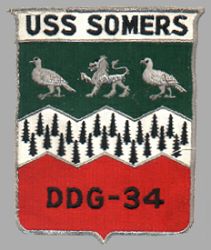 |  |
Commissioned as a FORREST SHERMAN - class destroyer, the USS SOMERS was the sixth ship in the Navy to bear the name. From April 1966 to February 1968, the SOMERS was converted to a guided missile destroyer and was redesignated as DDG 34. During the conversion, the SOMERS had 90% of her superstructure replaced and received the Tartar surface-to-air missile system and the ASROC antisubmarine rocket system. In addition, her engineering equipment was completely overhauled, and she received a lot of additional electronic gear.
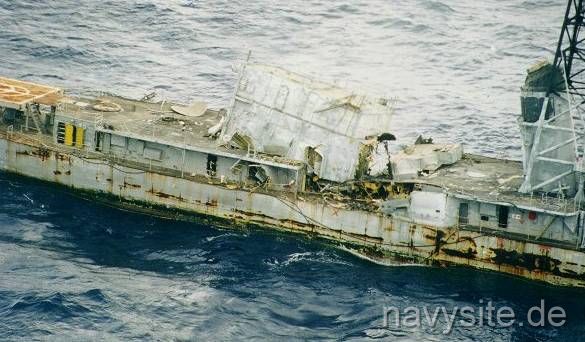
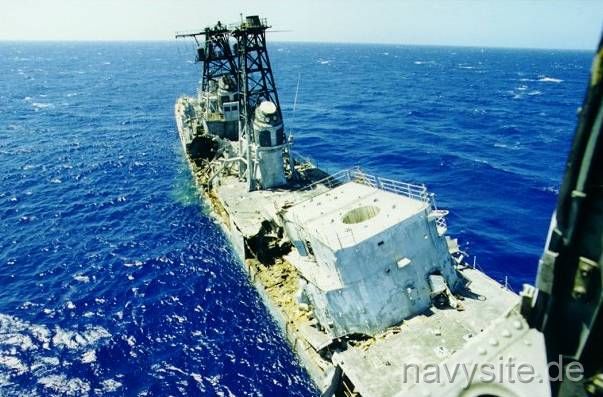
USS SOMERS was decommissioned after more than 23 years of service on November 19, 1982. She was stricken from the Navy list on April 26, 1988, and on July 22, 1998, the SOMERS was finally disposed of as a target north of Kauai, HI, at 022° 21' North, 160° 58' West.
| General Characteristics: | Keel laid: March 4, 1957 |
| Launched: May 30, 1958 | |
| Commissioned: April 3, 1959 | |
| Decommissioned: November 19, 1982 | |
| Builder: Bath Iron Works, Bath, Maine | |
| Propulsion system: four-1200 lb. boilers; two steam turbines; two shafts | |
| Propellers: two | |
| Length: 418.3 feet (127.5 meters) | |
| Beam: 45,3 feet (13.8 meters) | |
| Draft: 22 feet (6.7 meters) | |
| Displacement: approx. 4,150 tons full load | |
| Speed: 32+ knots | |
| Aircraft: none | |
| Armament: one Mk-42 5-inch/54 caliber guns, Mk-32 ASW torpedo tubes (two triple mounts), one Mk-16 ASROC missile launcher, one Mk-13 Mod.1 missile launcher for Standard MR missiles | |
| Crew: 25 officers, 339 enlisted |
 back to top go to the end of the pageback to top go to the end of the page
Crew List:
This section contains the names of sailors who served aboard USS SOMERS. It is no official listing but contains the names of sailors who submitted their information.
back to top go to the end of the pageback to top go to the end of the pageUSS SOMERS Cruise Books:
back to top go to the end of the page |
| USS Somers in her DD configuration serving as DD 947 |
back to top go to the end of the pageHistory of USS SOMERS:
USS SOMERS was laid down on 4 March 1957 by the Bath Iron Works Corp., at Bath, Maine, Iaunched on 30 May 1958; sponsored by Mrs. Charles E. Wilson; and commissioned on 3 April 1959, Comdr. Edward J. Cummings, Jr., in command.
On 1 June 1959, the destroyer sailed from Boston, Mass., to Newport, R.I., before departing the United States five days later for her maiden voyage which took her via Argentia, Newfoundland to the ports of northern Europe. On her itinerary were Copenhagen Denmark; Stockholm, Sweden; Portsmouth, England, and Kiel, Germany, where she represented the Navy during the "Kiel Week" festivities. SOMERS took leave of Europe at Portsmouth, England, and after stopping briefly at Bermuda and training for five days out of Guantanamo Bay, Cuba transited the Panama Canal on 19 July. She arrived at her home port, San Diego, Calif., on 27 July and conducted shakedown training along the California coast for the next six weeks. She underwent final acceptance trials on 17 September; then, completed just over a month of overhaul from 1 October until 8 November.
Over the next six and one-half years, SOMERS alternated between operations out of San Diego and deployments to the 7th Fleet in the Far East. In all, she deployed to the western Pacific four times during this period, remaining on the west coast in 1962 and 1964.
Her first three tours in the Far East were relatively uneventful, peacetime assignments, consisting of 7th Fleet operations and exercises with units of the navies of the SEATO allies of the United States. During her second and third deployments, in 1961 and 1963, SOMERS steamed to Australia to participate in the celebrations commemorating 19th and 21st anniversaries of the Battle of the Coral Sea. During her fourth tour of duty with the 7th Fleet, the destroyer saw her first wartime operations as American involvement in the Vietnam War escalated. She plied the waters of the Tonkin Gulf, plane-guarding for CORAL SEA (CVA 43), HANCOCK (CVA 19), and RANGER (CVA 61) as their aircraft pounded enemy supply lines in North Vietnam.
On 30 July 1965, SOMERS got underway from Yokosuka, Japan, to return to the United States. She arrived in San Diego on 12 August and, after a month of leave and upkeep, she resumed normal operations along the west coast. She continued to be so engaged until 11 April 1966 when she entered San Francisco Naval Shipyard to begin conversion to a DECATUR - class guided missile destroyer. On that day, she was decommissioned at Hunters Point. From then until February 1968, SOMERS was in the shipyard having 90% of her superstructure replaced, receiving the Tartar surface-to-air missile system and the ASROC antisubmarine rocket system. In addition, her engineering equipment was completely overhauled, and she received a lot of additional electronic gear. On 10 February 1968, SOMERS was recommissioned at Hunters Point as the Navy's newest guided-missile destroyer, DDG 34.
Her conversion was completed on 16 May 1968, and she departed Hunters Point the next day for her new home port, Long Beach, Calif. For the rest of 1968 and most of 1969, the guided-missile destroyer ranged the west coast from Mexico to the state of Washington, conducting trials and exercises.
On 18 November 1969, she got underway to deploy again to the western Pacific. She stopped over in Hawaii from 24 to 28 November and loaded ammunition at the Oahu Naval Ammunition Depot. Continuing westward, she paused at Midway on 1 December to refuel and at Guam on the 8th. She made Subic Bay in the Philippines on the 11th. During this deployment, SOMERS returned to the Gulf of Tonkin alternately planeguarding HANCOCK and serving on the gunline. During late March and early April, she joined units of the Australian and New Zealand navies in the SEATO exercise, "Sea Rover." After that, she returned to planeguard duties, this time for CONSTELLATION (CVA 64). Two days after joining the carrier, however, SOMERS was detached to return to Subic Bay. She arrived on 19 April and remained until the 24th, when she got underway for the United States.
SOMERS arrived at Long Beach on 8 May 1970. After an availability period and an extended leave and upkeep period, the guided-missile destroyer embarked 35 Naval Reserve Officer Training Corps midshipmen for five weeks training during PACMIDTRARON 70. The cruise commenced on 22 June and was concluded on 6 August at Long Beach. She resumed operations out of her home port until 13 November when she got underway for another deployment to the western Pacific. SOMERS was assigned to the 7th Fleet from December 1970 until 4 May 1971. During that time, she planeguarded the carriers on six occasions, rendered naval gunfire support on three, and once stood watch on the northern search and rescue station. In between line periods, she visited Keelung. Taiwan Hong Kong, Singapore, and Penang, Malaysia, in addition to putting in periodically at the naval station at Subic Bay.
She cleared the Gulf of Tonkin on 4 May, headed back to the United States, and made Long Beach on the 23rd. SOMERS resumed operations out of Long Beach until 9 July when she began a month of pre-overhaul preparations. On 9 August, the guided-missile destroyer entered Long Beach Naval Shipyard to commence regular overhaul. The overhaul lasted until 3 December and, following that, she went into a period of restricted availability which carried her through 31 December. SOMERS completed her restricted availability on 3 January 1972 and began trials, tests, and exercises which lasted through 31 March. After nine days of preparations, she headed west on 9 April to rejoin the 7th Fleet.
Sailing via Pearl Harbor and Guam, SOMERS made Subic Bay on 29 April. After a voyage to Singapore and back, she joined the carriers in the Gulf of Tonkin on 9 May. Her tour of duty in the Far East lasted until late October. She cruised with the aircraft carriers in the Gulf of Tonkin five times during this deployment, rendered naval gunfire support three times, and stood duty on the south Talos station and PIRAZ station once each. Between line periods, she normally put into Subic Bay, but managed to visit Sasebo, Japan, and Hong Kong. SOMERS returned to Long Beach on 9 November 1972.
Two periods of operations from her home port separated by two months of restricted availability at Long Beach took up the first nine months of 1973. On 9 October, she got underway to deploy to the western Pacific. Stopping at Pearl Harbor from 15 to 21 October, she made Subic Bay on 5 November. She remained on duty with the 7th Fleet until mid-May 1974, when she reentered Pearl Harbor. As of mid-October 1974, she was still in port at Pearl Harbor.
Routine local operations, training periods in the Hawaiian operating areas, and upkeep dominated her first months of 1975 as Seventh Fleet demand in Southeast Asia waned after the Paris Accords and the U.S. Navy adjusted force levels in the region.
In 1976, SOMERS continued that pattern of readiness out of Pearl Harbor - short underway periods for engineering and combat-systems drills punctuated by pier-side maintenance at Naval Station Pearl Harbor and work at the adjacent shipyard, the typical cycle for destroyers not on deployment. The broader geopolitical context for Pacific Fleet surface combatants that year was an increasing U.S. emphasis on the Indian Ocean as basing at Diego Garcia expanded and the Navy refined its ability to surge carrier battle groups into Southwest Asia - developments that shaped the workups Hawaii-based escorts like SOMERS were expected to support.
In 1977, SOMERS ranged farther afield again. A well-attested crew record places her on the Equator on 19 June 1977 - "shellback" ceremonies noted that day - evidence of an extended blue-water cruise that carried the ship into equatorial waters and back to the central Pacific. This equator crossing sits within a broader period of at-sea operations for the destroyer and signals the tempo building toward her next WestPac.
By 1978, SOMERS was clearly back at sea at speed: an official Navy photograph shows her underway in the Pacific on 30 March 1978 with her distinctive DDG silhouette and Tartar system forward. Late that year she departed Hawaii for another Western Pacific deployment with Seventh Fleet - open-source histories place the start of that cruise in November - returning the veteran FORREST SHERMAN-class hull to a familiar arena of carrier screening, anti-air warfare exercises, and presence patrols amid the shifting post-Vietnam balance in Asia.
Through 1979, SOMERS remained on deployment through the early months, operating with Seventh Fleet task groups and cycling through the Philippine Sea and approaches to the South China Sea before returning to Hawaii later that year. Crew rosters from the period, cruise book references, and veterans' recollections consistently place the ship on WestPac duties in 1978-1979 and back to Pearl Harbor before the long maintenance period that followed.
In 1980, SOMERS entered a lengthy regular overhaul at Pearl Harbor Naval Shipyard - sources describe a "51-week" shipyard period - emerging back to sea on 4 August 1980. The months that followed were devoted to the standard post-availability grind: trials, engineering shakedown, combat-systems testing, and certifications designed to re-qualify a guided-missile destroyer for battle-group work after yard work on hull, machinery, sensors, and weapons.
During 1981, the ship folded into the Pacific Fleet's large work-up architecture around Hawaii. Open-source accounts place SOMERS with "Battle Group Charlie" during READIEX 5-81 and then in the July FLEETEX 1-81 - a major multi-unit fleet exercise in the eastern-central Pacific - both designed to prepare west-coast and Hawaii-based groups for extended blue-water deployments. The chronology matches the theater-wide pivot of U.S. naval attention: sustained carrier and escort presence in the Arabian Sea/Indian Ocean in the wake of the 1979 Iran hostage crisis and related contingencies.
Late in 1981, SOMERS deployed again to the Western Pacific and Indian Ocean as part of the CONSTELLATION (CV 64) battle group. Carrier records fix USS CONSTELLATION's cruise from 20 October 1981 to 23 May 1982, with the group spending substantial time in the Arabian Sea, where U.S. forces maintained "Gonzo Station" presence. Open sources tie SOMERS to that formation and timeframe. The battle group's movements reflected the Carter-then-Reagan-era emphasis on Indian Ocean contingencies. Period command histories for CONSTELLATION record extended operations at sea, logistics through Diego Garcia, and multi-national events while the carrier and escorts cycled through Seventh Fleet and the Indian Ocean tasking.
In 1982, SOMERS completed that deployment and returned to Pearl Harbor in the late spring, then began the short glide path to retirement as newer destroyers and cruisers assumed a greater share of air-defense and screening duties. She decommissioned at Pearl Harbor on 19 November 1982 after more than twenty-three years in commission (including her pre-conversion service), closing her active career in the port that had been her home since 1973.
After decommissioning, SOMERS lay with the Inactive Ship Facility at Pearl Harbor and was struck from the Naval Vessel Register on 26 April 1988. She subsequently served for years at Port Hueneme as an instrumentation and test hulk before her final disposal during RIMPAC 1998. Towed to the Pacific Missile Range northwest of Kauai, she was first struck on 21 July 1998 by AGM-142 "Have Nap" missiles launched by USAF B-52s in a live-fire event and then scuttled on 22 July 1998 when an explosive-ordnance-disposal team placed charges aboard, sending her to deep water off Kauai.
SOMERS earned five battle stars during the Vietnam War.
back to top go to the end of the pageHomeports of USS SOMERS:
| Period | Homeport |
|---|---|
| commissioned at Boston, Mass. | |
| 1959 - 1966 | San Diego, Calif. |
| 1966 - 1973 | Long Beach, Calif. |
| 1973 - 1982 | Pearl Harbor, Hi. |
back to top go to the end of the page
USS SOMERS Image Gallery:
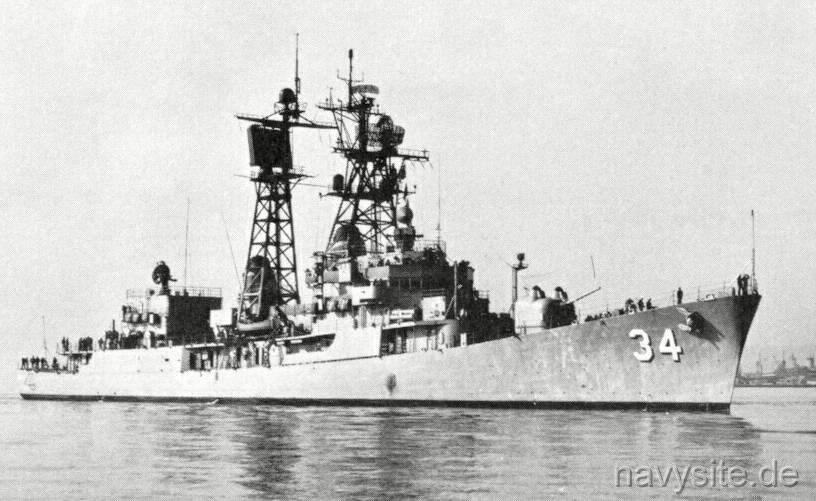 |
The photo below is an official US Navy photo taken on February 23, 1987. It shows the SOMERS at the Pearl Harbor Naval Inactive Ship Maintenance Facility.
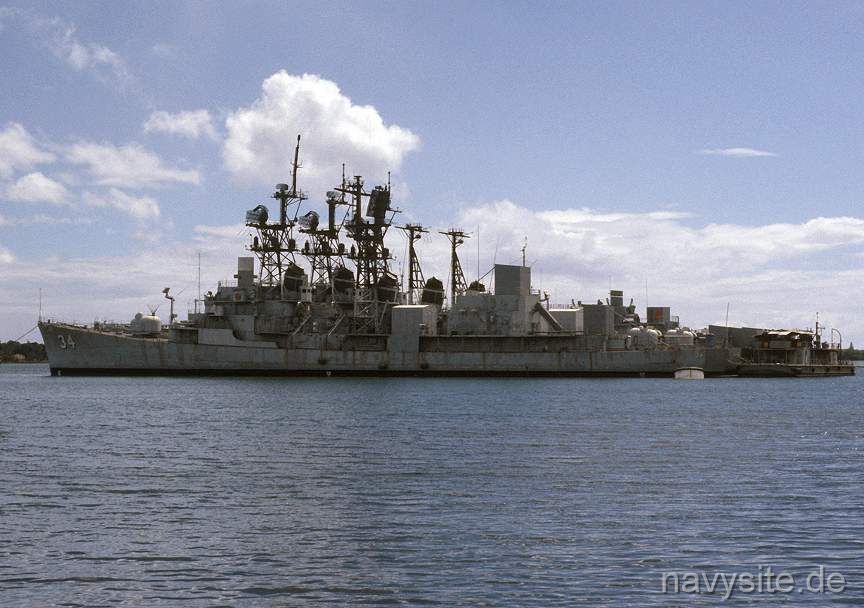 |
SINKEX Photos:
 | 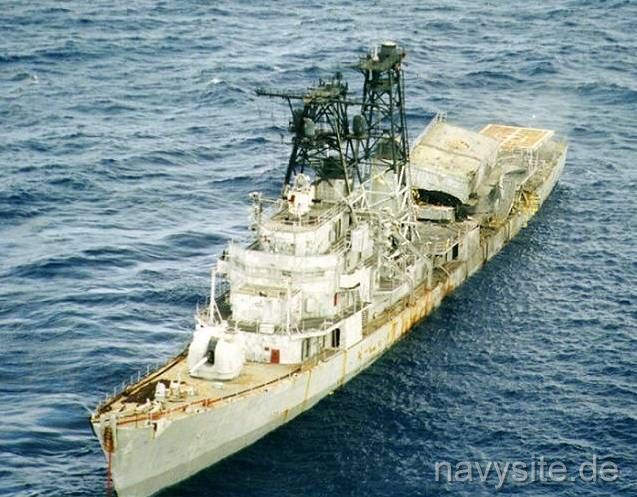 |  |  |
 |  |
back to top
 Back to Destroyers list. Back to ships list. Back to selection page. Back to 1st page.