![]() |
Search the Site with
|
![]() | ![]() | ![]() |
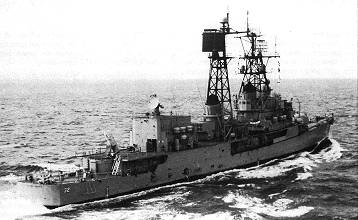
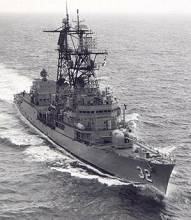
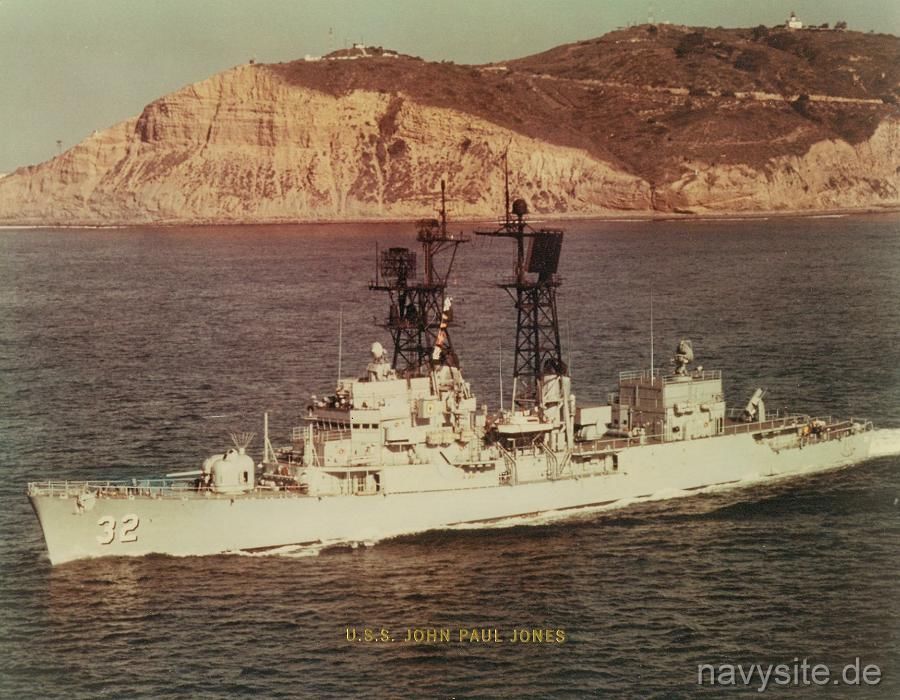
Commissioned as a FORREST SHERMAN - class destroyer, the USS JOHN PAUL JONES initially was designated DD 932. In December 1965, the JOHN PAUL JONES entered the Philadelphia Naval Shipyard for conversion to a guided missile destroyer. The conversion was finished in the fall of 1967 and the ship was redesignated as DDG 32. During the conversion, the JOHN PAUL JONES had 90% of her superstructure replaced and received the Tartar surface-to-air missile system and the ASROC antisubmarine rocket system. In addition, her engineering equipment was completely overhauled, and she received a lot of additional electronic gear.
USS JOHN PAUL JONES was decommissioned after more than 26 years of service on December 15, 1982. Stricken from the Navy list on April 30, 1986, the JOHN PAUL JONES was finally disposed of as a target off the coast of southern California at 032° 00' 06.0" North, 121° 36' 23.0" West. The Sinkex took place on January 31, 2001.
| General Characteristics: | Keel laid: January 18, 1954 |
| Launched: May 7, 1955 | |
| Commissioned: April 5, 1956 | |
| Decommissioned: December 15, 1982 | |
| Builder: Bath Iron Works, Bath, Maine | |
| Propulsion system: four-1200 lb. boilers; two steam turbines; two shafts | |
| Propellers: two | |
| Length: 418.3 feet (127.5 meters) | |
| Beam: 45,3 feet (13.8 meters) | |
| Draft: 22 feet (6.7 meters) | |
| Displacement: approx. 4,150 tons full load | |
| Speed: 32+ knots | |
| Aircraft: none | |
| Armament: one Mk-42 5-inch/54 caliber guns, Mk-32 ASW torpedo tubes (two triple mounts), one Mk-16 ASROC missile launcher, one Mk-13 Mod.1 missile launcher for Standard MR missiles | |
| Crew: 25 officers, 339 enlisted |
Crew List:
This section contains the names of sailors who served aboard USS JOHN PAUL JONES. It is no official listing but contains the names of sailors who submitted their information.
USS JOHN PAUL JONES Cruise Books:
About the Ship's Name, about Commodore John Paul Jones:
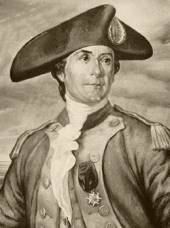
USS JOHN PAUL JONES honored the Father of the American Navy. Born in Scotland, Commodore John Paul Jones earned the undying respect and admiration of his countrymen by his extraordinary courage, tactical genius and audacity during the American War for Independence. Without hesitation, he single-handedly took the war at sea to the British, attacking their coastlines and capturing their ships in the British fleets' home waters. These acts inspired and transformed the fledgling Colonial Navy from an upstart band of rebels to a recognized fighting force, providing critical support for the colonies and their bid for independence from Great Britain. John Paul Jones is best remembered for his heroic defeat of the British 50-gun frigate SERAPIS on 23 September 1779. The three hour battle off Flamborough Head, in which John Paul Jones, in command of BONHOMME RICHARD, was victorious over a vastly superior British foe, established the spirit from which has grown the greatest navy the world has ever known.
USS JOHN PAUL JONES History:
USS JOHN PAUL JONES began life as a FORREST SHERMAN-class destroyer, laid down at Bath Iron Works on January 18, 1954, launched on May 7, 1955, and commissioned as JOHN PAUL JONES (DD 932) on April 5, 1956, at Boston. After trials off New England she ran a full shakedown out of Guantanamo Bay and then crossed to Northern Europe, including visits around the British Isles that tied the ship symbolically to her namesake's Scottish origins, before returning to her first homeport at Newport on October 8, 1956. Early Cold War operations on the Atlantic seaboard set the rhythm for her first years in commission.
On March 25, 1957, she sailed for a first Mediterranean deployment with the SIXTH FLEET. In May 1957, she stood ready during the Jordanian crisis in support of King Hussein, one of several rapid-response episodes of that era as Washington used naval forces to stabilize partners and deter Soviet influence ashore, then headed home to Newport on June 6. NATO maneuvers followed that autumn in the North Atlantic. A brief late-1957 return to the Mediterranean and fleet exercises in the Caribbean in January 1958 sharpened anti-submarine and air-defense skills that framed her role for the next several years.
Through 1958-1959, she alternated East Coast training and Canadian navy drills with further Mediterranean duty, departing March 17, 1959, for four months with SIXTH FLEET and returning to Boston on July 24. The 1960 operating year opened with 2ND FLEET work, followed by a midshipmen cruise, and then a major Southern Hemisphere assignment: departing August 22, 1960, for Operation UNITAS, she circumnavigated South America with allied navies, exercised in both oceans, transited the Strait of Magellan, and returned to Newport on December 13 after passing through the Panama Canal.
During 1961-1962, she focused on anti-submarine warfare off the East Coast and in the Caribbean. In April 1962, JOHN PAUL JONES sailed in a fleet review and weapons demonstration for President John F. Kennedy, then completed a summer midshipmen period and served in October with Atlantic Recovery Forces for Mercury-Atlas 8, the orbital flight of Commander Walter M. Schirra Jr. Soon afterward, she took station off Cuba as part of the naval quarantine during the Cuban Missile Crisis, a peak of superpower confrontation in which destroyers' surveillance, identification, and intercept roles were central to Kennedy's strategy.
She deployed again to the Mediterranean from February 6 to July 1, 1963, and, after more Atlantic work, returned to the Med on June 20-September 3, 1964, concentrating on Western Mediterranean anti-submarine assignments with SIXTH FLEET. Early in 1965, JOHN PAUL JONES joined Operation Springboard in the Caribbean, then on March 19 took station roughly 200 miles south of Bermuda as a contingency recovery ship for Gemini 3, before entering another summer NATO phase in the Mediterranean beginning June 18. These successive assignments capped her first decade as a gun destroyer.
On December 20, 1965, she decommissioned at Philadelphia for a major guided-missile conversion that replaced her forward 5-inch gun with a Mk 13 Tartar surface-to-air missile launcher and added modern sensors and combat systems. Reclassified as a guided-missile destroyer on March 15, 1967, and recommissioned on September 23, 1967, as JOHN PAUL JONES (DDG 32), she shifted to the Pacific Fleet and began West Coast training out of Long Beach for Western Pacific duty.
Combat deployments to Southeast Asia followed. After earlier WestPac tours in 1968-1970 supporting Task Force 77 carriers and coastal operations, the ship's 1972 command history documents a precisely sequenced cruise: on January 7, 1972, she departed Long Beach in company with the carrier HANCOCK (CVA 19), the destroyer HIGBEE (DD 806), and the escort FRANCIS HAMMOND (DE 1067), arriving Subic Bay on February 3. Over the next months she alternated radar-picket and air-control duties in the Gulf of Tonkin, plane-guard and screen station with HANCOCK's air wing during the spring escalation that included Operation Linebacker, and periodic gunline tasks, interleaving upkeep at Subic and brief calls in Japan as the theater tempo intensified. The 1972 deployment closed out in late summer with turnover and the return to Southern California.
With the Paris talks moving toward a cease-fire, JOHN PAUL JONES returned west in 1973 for another Far East period. As U.S. naval operations in Vietnamese waters shifted from sustained combat to cease-fire enforcement and mine-clearance support, she performed anti-air picket and coordination roles in the Tonkin Gulf and supported the mine-removal regime around Haiphong from seaward as dedicated sweepers and helicopter squadrons executed Operation End Sweep. In August 1973, she participated in multinational exercises with Australian, New Zealand, and British units before returning to Long Beach in November, reflecting a broader U.S. and allied pivot back to coalition training after years of combat.
The 1974-1975 cycle brought another Western Pacific deployment - this one defined by regional collapse onshore. In April 1975, a rapid sequence of evacuations ended U.S. involvement on the Indochina peninsula. Sources associated with ship and crew records place JOHN PAUL JONES among the surface escorts during Operations Eagle Pull (Phnom Penh, April 12) and Frequent Wind (Saigon, April 29-30), when a large U.S. task group extracted American citizens and thousands of at-risk Vietnamese to ships offshore. In those final days she operated with other Seventh Fleet units - including destroyers such as HENRY B. WILSON (DDG-7) - as helicopter flows surged to command ships and amphibious platforms in the South China Sea.
After an overhaul in 1976 the destroyer resumed Pacific Fleet duty. In 1977, she is recorded operating off Oahu on August 12 - representative of the intermediate training and missile-system exercises that kept readiness high as the Navy absorbed lessons from Vietnam into fleet air-defense doctrine. A WestPac cruise from April to October 1978 followed, including joint events with forces from Taiwan and the Philippines as Washington encouraged partner-navy interoperability across the first island chain.
A final sequence of forward operations came with the Iranian Revolution and the protracted hostage crisis. After a late-1979 WestPac/Indian Ocean deployment began amid that shock to the regional order, JOHN PAUL JONES joined the expanded U.S. presence on "Gonzo Station" in the Arabian Sea, part of the largest American naval concentration in the Indian Ocean since World War II. In 1980, she is noted alongside STANDLEY (CG 32) and SCHOFIELD (FFG 3) as ships relieving a carrier battle group on station. Her duties included screen, plane-guard, and air-defense picket for carriers such as CONSTELLATION (CV 64), whose record-length at-sea periods underscored the geopolitical stakes. The destroyer's seakeeping and missile battery - modernized again in the 1970s - fit the extended, austere logistics of that line-period.
Returning to the West Coast, JOHN PAUL JONES completed her last stateside operating periods and decommissioned on December 15, 1982, as the Navy consolidated around newer air-defense combatants. She was stricken from the Naval Vessel Register on November 30, 1985, and, after serving as a parts hulk, was sunk as a target off California on January 31, 2001 - ending the service life of a destroyer that had spanned from the high-tension Mediterranean of the 1950s to the closing acts of the Vietnam War and onward to the Indian Ocean crisis of 1979-1980.
Homeports of USS JOHN PAUL JONES:
| Period | Homeport |
|---|---|
| commissioned at Boston, Mass. | |
| 1956 - 1965 | Newport, RI. |
| 1965 - 1982 | Long Beach, Calif. |
USS JOHN PAUL JONES Image Gallery:
![]() |
Back to Destroyers list.
Back to ships list.
Back to selection page.
Back to 1st page.