Search the Site with 
General Characteristics Crew List Memorabilia Cruise Books Accidents aboard the Ship About the Ship's Name History Image Gallery to end of page

USS Reeves (CG 24)

- formerly DLG 24 -
- decommissioned -
- sunk as a target -


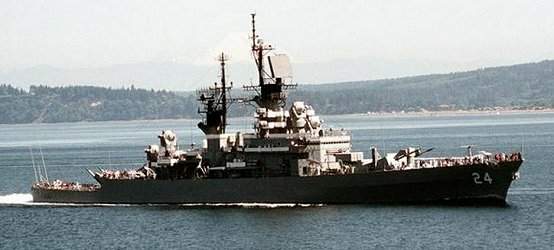
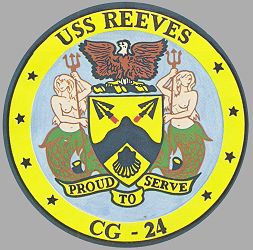
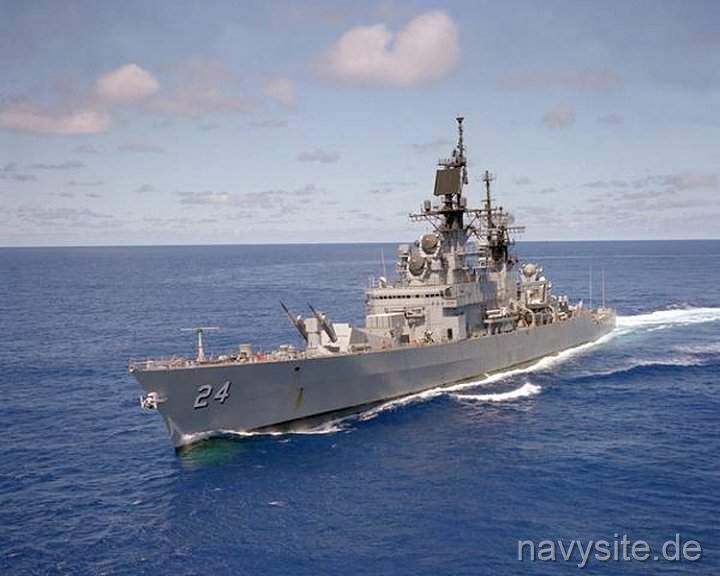
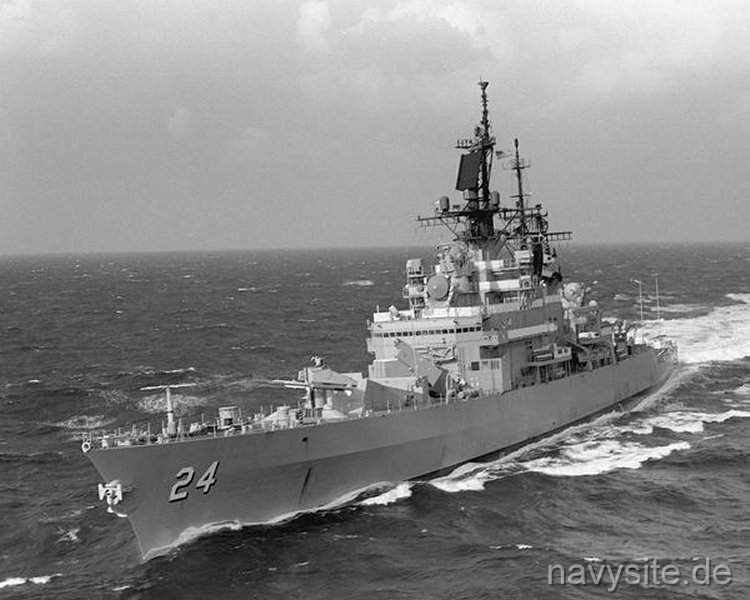
USS REEVES was the last ship in the LEAHY-class of guided missile cruisers. She was the second ship in the Navy to bear the name, but the first ship named after Vice Admiral Joseph Mason Reeves. Commissioned as a guided missile frigate, REEVES was reclassified as guided missile cruiser on June 30, 1975.

REEVES was decommissioned and stricken from the Navy Register on November 12, 1993, at Pearl Harbor. The ship was then berthed at the Naval Inactive Ship Maintenance Facility (NISMF), Pearl Harbor, HI. On May 31, 2001, the REEVES was finally sunk as a target.

General Characteristics:Keel laid: July 1, 1960
Launched: May 12, 1962
Commissioned: May 15, 1964
Decommissioned: November 12, 1993
Builder: Puget Sound Naval Shipyard, Bremerton, Wash.
Propulsion system:4 - 1200 psi boilers; 2 General Electric geared turbines
Propellers: two
Length: 535 feet (163 meters)
Beam: 53 feet (16.1 meters)
Draft: 26 feet (7.9 meters)
Displacement: approx. 7,800 tons
Speed: 30+ knots
Aircraft: none
Armament: two Mk 141 Harpoon missile launchers, two 20mm Phalanx CIWS, two Mk-10 missile launchers for Standard missiles (ER), Mk 46 torpedoes from two Mk-32 triple mounts, one Mk 16 ASROC missile launcher
Crew: 27 officers and 413 enlisted


Back to topback to top  go to endgo to the end of the page


Back to topback to top  go to endgo to the end of the page

Crew List:

This section contains the names of sailors who served aboard USS REEVES. It is no official listing but contains the names of sailors who submitted their information.


back to top  go to the end of the page


Back to topback to top  go to endgo to the end of the page

USS REEVES Cruise Books:


Back to topback to top  go to endgo to the end of the page

Accidents aboard USS REEVES:

DateWhereEvents
October 30, 198932 miles south of Diego GarciaAn F/A-18 aircraft from USS MIDWAY (CV 41) mistakenly drops a 500-pound bomb on the deck of the USS REEVES during traing exercises in the Indian Ocean, creating a five-foot hole in the bow, sparking small fires, and injuring five sailors.


Back to topback to top  go to endgo to the end of the page

About the Ship's Name:

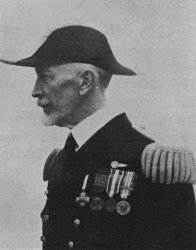
Joseph Mason Reeves, born in Tampico, III., on 20 November 1872, graduated from the Naval Academy in 1894. Initially assigned to SAN FRANCISCO (Cruiser No. 5), he served in OREGON (BB 3) during the Spanish-American War, participating in the action against Admiral Cervera's fleet at Santiago in June and July 1898.

After the turn of the century, he served in SAN FRANCISCO, WISCONSIN (BB 9), and OHIO (BB 12) in addition to tours ashore at Newport and the Naval Academy, where he was an instructor in the Department of Physics and Chemistry (1906-08). Following duties as ordnance officer on board NEW HAMPSHIRE (BB 25), he served as ordnance officer in the staff of the Commander in Chief, U.S. Atlantic Fleet. Assignment to the Board of Inspection and Survey and a tour as Commanding Officer, Naval Coal Depot, Tiburon, Calif., followed.

In April 1913 he assumed command of JUPITER (Collier No. 3), the Navy's first electrically propelled vessel. Detached in April 1914, he commanded ST. LOUIS (Cruiser No. 20) and various other ships until assigned to OREGON, June 1915, as Commanding Officer. Detached for shore duty at the Mare Island Navy Yard, in June 1916, he commanded MAINE (BB 10) during World War I, earning the Navy Cross for "exceptionally meritorious service" during that tour.

After the war, he served as Naval Attache at Rome and in April 1921 assumed command of the armored cruiser PITTSBURGH (CA 4). Captain of the Mare Island Navy Yard at the end of that year, he commanded NORTH DAKOTA (BB 29), 1922-23, then attended and afterward served on the staff of the War College at Newport. After October 1925, he twice served as Commander, Aircraft Squadrons, Battle Fleet, interspersed with duty on the General Board, June 1929-June 1930. Fifteen months later he became Senior Member of the Board of Inspection and Survey, Pacific Coast Section. Another tour at Mare Island followed and in June 1933 he became Commander, Battleships, Battle Force, with the rank of vice admiral. Assigned Commander, Battle Force, U.S. Fleet, with the rank of admiral, the following month, he was designated Commander-in-Chief, U.S. Fleet, on 26 February 1934. In June 1936 he was ordered to Washington, D.C., where he served on the General Board until 23 November. Retired seven days later he was recalled to active duty on 13 May 1940. Advanced to vice admiral on the retired list, he served in the Office of the Secretary of the Navy from 21 May 1940 until 23 December 1946. He died at Bethesda, Md., on 25 March 1948.


Back to topback to top  go to endgo to the end of the page

USS REEVES History:

USS REEVES entered service at Puget Sound Naval Shipyard on May 15, 1964, and spent the remainder of that year in trials, shakedown, and missile/gunnery certifications before joining the Pacific Fleet at Long Beach. Her first Western Pacific cruise began on April 10, 1965, screening carriers on air-defense picket duty off Vietnam and alternating plane guard with radar and identification control in the Gulf of Tonkin. She returned to Long Beach on November 3, 1965. A shift to forward presence followed: on June 16, 1966, REEVES arrived at Yokosuka for a two-year non-rotated tour, cycling south for repeated combat air-sea rescue and PIRAZ periods off Vietnam. That Yokosuka-Tonkin shuttle produced a heavy operating tempo - over 300 days in the Gulf by mid-1968 - with brief port resets in Subic Bay, Hong Kong, Sasebo/Yokosuka, and Kaohsiung before she rotated back to the West Coast in August 1968. The ship entered major modernization at Bath Iron Works, was placed out of commission (special) on April 10, 1969, then recommissioned on August 29, 1970 and ferried to her new home port, Pearl Harbor, via a long passage that included three weeks of refresher training at Guantanamo Bay. After workups in Hawaiian waters, REEVES deployed again to the Gulf of Tonkin in mid-1971 (returning to Pearl Harbor on December 20, 1971) and then a second post-overhaul WestPac from September 18, 1972 to March 17, 1973. She remained a Hawaii-based unit through the mid-1970s. As part of a Navy-wide redesignation on June 30, 1975, the ship became CG 24, aligning title with her primary role in long-range air defense for carrier task forces.

The end of the 1970s and the Iranian hostage crisis pulled REEVES into a broader operating box that increasingly included the North Arabian Sea. That shift culminated in a forward-deployed chapter: on August 14, 1980, REEVES arrived at Yokosuka to relieve USS WORDEN (CG 18) as the Seventh Fleet's resident cruiser. Crews cross-decked on August 19, 1980, so the outgoing ship could sail east while REEVES stayed in Japan. In this period she was a fixture in Battle Group ALFA centered on USS MIDWAY (CV 41), acting as AAW picket and air-picture manager during WestPac and Indian Ocean segments. A composite 1981 cruise ran February 24, 1981 - June 5, 1981, including exercises with the Royal Australian Navy and a port visit to Perth/Fremantle (May 6 - 11, 1981). Between deployments the ship completed repairs and inspections in Yokosuka and kept proficiency sharp with missile exercises and replenishment drills around the Philippines and Japan.

REEVES' most publicized Cold War port call came in November 1986, when she led the first U.S. Navy visit to the People's Republic of China since 1949. After Team Spirit exercises off Korea in March 1986 and special surveillance operations in the Northwest Pacific that autumn, the cruiser entered Qingdao on November 5, 1986, for a six-day stay, accompanied by USS RENTZ (FFG 46) and USS OLDENDORF (DD 972), with the Pacific Fleet commander embarked. The visit featured shipboard exchanges on propulsion, logistics, and weapons management, and shore tours organized by Chinese hosts. It signaled a short-lived opening in Sino-American military contacts during the late Cold War.

A Middle East turn followed. From July 23, 1987, into September 1987, REEVES escorted reflagged tankers through the Strait of Hormuz during Operation Earnest Will, then resumed the forward-deployed WestPac routine - Korean Team Spirit in March 1988, patrols in the Philippine and South China Seas, and workups with MIDWAY's air wing. On June 26, 1989, she rescued 92 Vietnamese refugees from a sinking vessel in the South China Sea, transferring them a week later to a U.N. organization in Thailand. Four months later, during night training south of Diego Garcia, an F/A-18 from MIDWAY inadvertently released a 500-pound bomb onto REEVES' foredeck (October 30, 1989), blowing a five-foot hole near the forward missile house and injuring five sailors. Fires were quickly contained and the ship continued with repairs and inspections afterward.

In 1990, REEVES closed her eleven-year Japan tour and pivoted to overhaul. The ship's command chronology shows maintenance in Yokosuka through February 25, 1990, followed by Team Spirit 1990 support (February 25-March 4) and a short visit to Busan (March 4-5). After "special operations off the coast of the USSR" (March 5-6) and inspections in the Yokosuka operating areas, she entered a sequence of local upkeeps and at-sea periods, then sailed south on August 17, 1990, en route Subic Bay (August 23-27), continued to Singapore (August 31-September 3) for MERCUB 90 (September 3-7), and operated with USS OLDENDORF during INDUSA 16 (September 9-14). Additional Southeast Asia engagements included Lumut, Malaysia (September 14-16) and MEKAR 90 in the South China Sea (September 16-24), followed by Jakarta (September 24-27) and Hong Kong (October 3-8). REEVES reached Pearl Harbor on October 23, 1990, off-loaded ammunition (October 24), defueled (October 25), completed a pre-overhaul restricted availability (October 26-November 25), and on November 26, 1990, commenced a combined New Threat Upgrade/regular overhaul at Pearl Harbor Naval Shipyard. On July 1, 1990, in parallel with these movements, her administrative home port shifted from Yokosuka to Pearl Harbor.

The NTU overhaul modernized REEVES' air-defense suite - integrating AN/SPS-48E/-49 air-search radars, SPG-55B fire-control, and a refreshed combat-direction system to employ SM-2ER effectively - then rolled into trials and workups through 1991. With yard work completed, the cruiser re-entered the fleet's training circuit and made a public appearance in the Pacific Northwest: imagery places her in Elliott Bay during Seafair 1992 in Seattle, a late-summer outreach port call that doubled as a shakedown milestone.

REEVES' final year was one of steady operations and drawdown preparation. Retaining Pearl Harbor as home port, she supported local exercises and group events while the Navy accelerated retirement of steam-powered, manpower-intensive cruisers in favor of newer Aegis units. She decommissioned and was stricken on November 12, 1993, at Pearl Harbor, then remained in inactive status until a SINKEX off Queensland during a U.S.-Australian exercise on May 31, 2001, sent the hull to the deep.


Back to topback to top  go to endgo to the end of the page


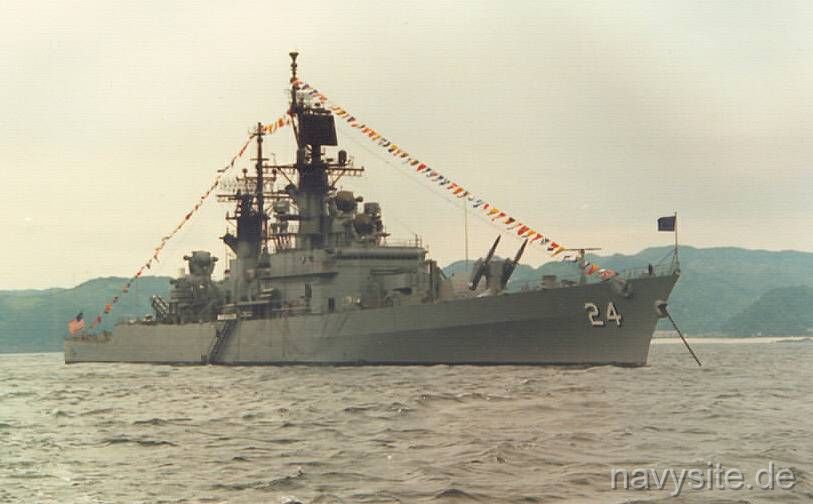
The photo below was taken by Scott R. Fansler and shows the REEVES at anchor at Shimoda, Japan, on May 17, 1989.


Back to topback to top


Back to Cruisers list. Back to ships list. Back to selection page. Back to 1st page.