
Search the Site with

|
Search the Site with
|
 General Characteristics Crew List Memorabilia Cruise Books USS Halsey's COs About the Ship's Name History Image Gallery to end of page
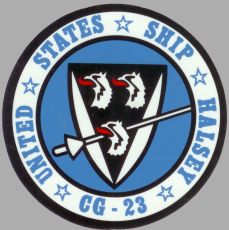 Coat of Arms contributed by Douglas West | 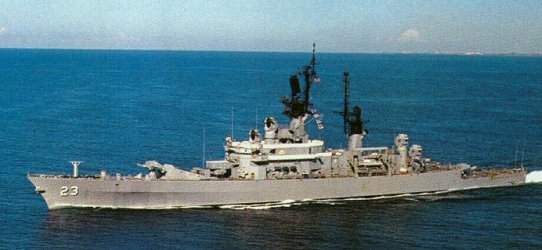 |
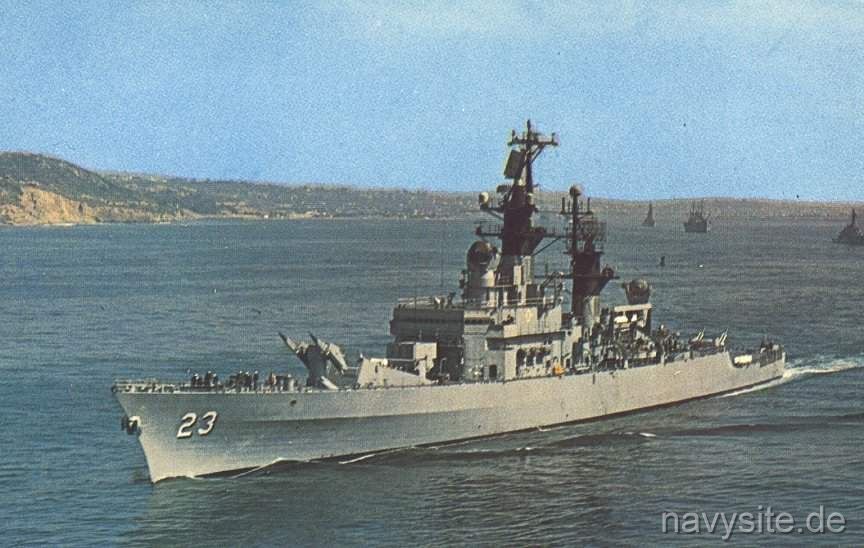
USS HALSEY was the eighth ship in the LEAHY-class of guided missile cruisers and the first ship in the Navy named after Fleet Admiral Halsey. The commissioning ceremony of USS HALSEY even included a eulogy by Fleet Admiral Chester W. Nimitz, USN, on Fleet Admiral Halsey's illustrious career.
Commissioned as a guided missile frigate and later reclassified a guided missile cruiser on June 30, 1975, HALSEY was decommissioned and stricken from the Navy Register on January 28, 1994 at San Diego. Transferred March 7 the same year to the Maritime Administration, she was laid up at the Suisun Bay, CA. reserve to await final disposal. HALSEY was sold to International Shipbreaking Corp., Brownsville, Tx., for scrapping.
| General Characteristics: | Keel laid: August 26, 1960 |
| Launched: January 15, 1962 | |
| Commissioned: July 20, 1963 | |
| Decommissioned: January 28, 1994 | |
| Builder: San Francisco Naval Shipyard, San Francisco, Ca. | |
| Propulsion system:4 - 1200 psi boilers; 2 General Electric geared turbines | |
| Propellers: two | |
| Length: 535 feet (163 meters) | |
| Beam: 53 feet (16.1 meters) | |
| Draft: 26 feet (7.9 meters) | |
| Displacement: approx. 7,800 tons | |
| Speed: 30+ knots | |
| Aircraft: none | |
| Armament: two Mk 141 | |
| Crew: 27 officers and 413 enlisted |
 back to top go to the end of the pageback to top go to the end of the page
Crew List:
This section contains the names of sailors who served aboard USS HALSEY. It is no official listing but contains the names of sailors who submitted their information.
back to top go to the end of the pageback to top go to the end of the pageUSS HALSEY Cruise Books:
back to top go to the end of the pageUSS HALSEY's Commanding Officers:
| Period | Name |
|---|---|
| July 20, 1963 - October 7, 1964 | Captain H. H. Anderson, USN |
| October 7, 1964 - September 10, 1965 | Captain G. W. Ringenburg, USN |
| September 10, 1965 - July 6, 1967 | Captain J. J. LeBourgeois, USN |
| July 6, 1967 - October 14, 1968 | Captain V. L. Murtha, USN |
| October 14, 1968 - December 10, 1969 | Captain W. E. Harper, Jr., USN |
| December 10, 1969 - November 4, 1971 | Captain J. A. Hooper, USN |
| December 16, 1972 - November 22, 1974 | Captain J. D. Nolan, USN |
| November 22, 1974 - March 18, 1977 | Captain W. F. McCauley, USN |
| March 18, 1977 - May 19, 1979 | Captain S. J. Hostettler, USN |
| May 19, 1979 - May 12, 1981 | Captain R. R. Tarbuck, USN |
| May 12, 1981 - May 27, 1983 | Captain R. L. Wyatt, USN |
| May 27, 1983 - August 29, 1985 | Captain P. D. Moses, USN |
| August 29, 1985 - January 8, 1988 | Captain D. R. Conley, USN |
| January 8, 1988 - September 13, 1989 | Captain R. D. Pacek, USN |
| September 13, 1989 - April 2, 1992 | Captain G. A. Klien III, USN |
| April 2, 1992 - January 28, 1994 | Captain L. P. Amborn, USN |
back to top go to the end of the pageback to top go to the end of the pageUSS HALSEY History:
USS HALSEY entered service on July 20, 1963, joining the Pacific Fleet from Southern California after trials and weapons calibrations, and quickly settled into the classic Seventh Fleet rhythm that defined a generation of double-ended missile ships. Through the mid- and late-1960s she made repeated Western Pacific deployments in support of the Vietnam air war, rotating between PIRAZ and air-defense picket stations in the Gulf of Tonkin, plane-guard and search-and-rescue duty alongside the carriers, and surface-screen commander roles during multi-carrier surges. Her long line periods were punctuated by tightly scheduled logistics and liberty stops - ordnance turns and repairs at Subic Bay, brief resets at Yokosuka or Sasebo, and short visits to Kaohsiung, Hong Kong, and Singapore - before she returned to Southern California for inspections, missile shoots, and refresher training. As the tempo spiked again in 1972 during the Linebacker campaigns, the ship's contribution remained steady and technical: building and holding the recognized air picture, controlling fighters, and coordinating identification and deconfliction while the carrier air wings executed mining and interdiction along North Vietnam's supply routes.
As combat operations tapered, HALSEY continued forward presence runs while absorbing incremental upgrades to sensors, combat-direction spaces, and the Terrier/Standard battery. The Navy's fleet-wide redesignation on June 30, 1975, reclassified her from DLG 23 to CG 23, aligning title with the role she already performed: long-range area air defense in carrier groups. By the late 1970s her operating box widened beyond the familiar Western Pacific lanes into the Indian Ocean and Arabian Sea, a shift driven by crises around the Horn of Africa, the aftershocks of the Iranian Revolution, and sustained Soviet naval activity. Typical blue-water patrols in those years ran Pearl Harbor to the Western Pacific, then south and west to the Arabian Sea with waypoints at Singapore, Diego Garcia, or Mombasa, before reversing the route for post-deployment maintenance at home. Large fleet exercises - RIMPAC events out of Hawaii, coordinated AAW and ASW serials with the Japan Maritime Self-Defense Force, and high-end replenishment and gunnery drills - kept watch teams current and validated upgrades. Yard time centered on Long Beach Naval Shipyard and industrial piers in Southern California, bundling hull preservation and electronics reliability work so an aging but still capable air-defense cruiser could remain on the line.
The most consequential modernization came in the mid-to-late 1980s, when HALSEY underwent the New Threat Upgrade (NTU), a deep refresh of radars, fire control, and the combat-direction system that allowed full employment of SM-2 missiles and far better management of dense air pictures around a carrier. Post-availability trials and missile exercises gave way to another round of workups and deployment, again with a strong Arabian Sea emphasis as U.S. attention stayed fixed on sea-lane security and regional deterrence. In between, she continued multinational training - RIMPAC-linked evolutions from Pearl Harbor, bilateral AAW/ASW periods with Japanese forces, and occasional calls at Yokosuka, Sasebo, or Busan tied to those events - while short Pacific port visits provided the only real breaks from long, fuel-and-sortie-heavy patrols. Her port-call pattern remained purposeful rather than touristic: Subic Bay for ammunition and repair; Yokosuka/Sasebo for upkeep and allied engagement; Hong Kong and Singapore for brief liberty; Diego Garcia and Mombasa as Indian Ocean waypoints.
The early post–Cold War years emphasized maritime security and sanctions enforcement even as lifecycle realities caught up with steam-powered, manpower-intensive hulls. Air-defense cruisers like HALSEY provided command-and-control depth to screening forces, fusing air and surface pictures for boarding units and maritime patrol aircraft while newer Aegis ships increasingly shouldered the fleet's long-range air-defense mission. HALSEY continued to execute workups and shorter deployments, cycling through the Navy's maintenance cadence to keep legacy combat systems reliable and safe through her final operating years. She decommissioned on January 20, 1994, closing more than three decades that ran from Vietnam PIRAZ duty through late-Cold-War Indian Ocean presence and into the early-1990s transition to embargo and crisis-management missions, with a throughline of disciplined air-defense watchstanding, tightly planned upkeep, and brief, functional port calls stitched between long stretches at sea.
back to top go to the end of the pageUSS HALSEY Image Gallery:
 |  |
back to top
 Back to Cruisers list. Back to ships list. Back to selection page. Back to 1st page.