
Search the Site with

|
Search the Site with
|
 General Characteristics Crew List History Image Gallery to end of page
 | Sorry, no coat of arms available. |
USNS NARRAGANSETT was the second POWHATAN - class fleet ocean tug. Deactivated on October 18, 1999, and stricken from the Navy list on June 5, 2002, the NARRAGANSETT transfered to the Naval Air Warfare Center at Patuxent River, Md, on August 2, 2002. There, the tug was used as tow and service vessel. Since 2016, NARRAGANSETT is serving as Training Support Vessel "TSV 4" operating out of Joint Expeditionary Base Little Creek-Fort Story, Virginia.
The NARRAGANSETT is equipped with a 10-ton capacity crane and a bollard pull of at least 54 tons. A deck grid is fitted aft which contains 1 inch bolt receptacles spaced 24 inches apart. This allows for the bolting down of a wide variety of portable equipment. There are two GPH fire pumps supplying three fire monitors with up to 2,200 gallons of foam per minute. A deep module can be embarked to support naval salvage teams.
| General Characteristics: | Awarded: September 12, 1975 |
| Keel laid: May 5, 1977 | |
| Launched: May 12, 1979 | |
| Delivered: November 9, 1979 | |
| Deactivated: October 18, 1999 | |
| Builder: Marinette Marine Corp., Marinette, WI. | |
| Propulsion system: 2 GM EMD 20-645F7B diesels; 5.73 MW sustained; 2 shafts; cp props; bow thruster; 300 hp (224 kW) | |
| Propellers: two | |
| Length: 226 feet (68.9 meters) | |
| Beam: 42 feet (12.8 meters) | |
| Draft: 15.1 feet (4.6 meters) | |
| Displacement: approx. 2,260 tons full load | |
| Speed: 14.5 knots | |
| Aircraft: none | |
| Armament: none | |
| Crew: 16 civilians and 4 naval communications technicians |
 back to top go to the end of the pageback to top go to the end of the page
Crew List:
This section contains the names of sailors who served aboard USNS NARRAGANSETT. It is no official listing but contains the names of sailors who submitted their information.
back to top go to the end of the pageUSNS NARRAGANSETT History:
USNS NARRAGANSETT was laid down at Marinette Marine, Marinette, Wisconsin, on May 5, 1977, launched on May 12, 1979, and delivered to the U.S. Navy for Military Sealift Command service on November 9, 1979. Crewed by civilian mariners under MSC with a small Navy communications detachment, the 240-foot fleet ocean tug entered service with a 4,500-shp twin-screw propulsion plant, a SMATCO 66 DTS-200 towing winch, and an open 4,000-square-foot working deck designed for long-range tows, salvage assistance, and mobile support tasks across the Pacific and Indian Oceans.
Through 1980 and 1981, NARRAGANSETT operated in the Iran/Indian Ocean area amid the tense post-hostage-crisis period, work that would later be recognized with the Navy Expeditionary Medal for those years. Routine towing and logistics support were interspersed with availability periods on the U.S. West Coast as the ship settled into a rhythm of Pacific assignments.
In the aftermath of the downing of KOREAN AIR LINES FLIGHT 007 on September 1, 1983, NARRAGANSETT deployed from Pusan, South Korea, in the fall of 1983 to the Sea of Japan west of Sakhalin Island. Embarking acoustic pinger-locator equipment and a deep-diving remotely operated vehicle, she executed search patterns for the aircraft's flight recorders under close Soviet surface surveillance. Although the recorders were not recovered, the effort earned the ship a Meritorious Unit Commendation, and it anchored her reputation for precision seakeeping and station-holding in marginal weather during high-visibility investigations.
On April 25-26, 1984, the tank landing ship USS BARBOUR COUNTY (LST 1195) broached and grounded on the Silver Strand amphibious boat area at Coronado, California. NARRAGANSETT joined the multi-day refloat and salvage response off San Diego, working in the congested surf zone and assisting with towing evolutions and post-refloat handling as the LST was brought back to deep water and then to port. A Defense Department aerial series taken on August 2, 1984, captured the ship still hard aground during the extended recovery effort, a visual marker of the prolonged sequence of tides, rigging, and tows needed to free her. In July 1984, in a separate heavy-lift assignment, NARRAGANSETT towed the ocean construction platform SEACON from Panama to San Diego to support West Coast seabed infrastructure work.
In 1990, NARRAGANSETT again supported an aviation safety investigation after UNITED AIRLINES FLIGHT 811 lost a cargo door departing Honolulu. During the July 1990 seabed search off Hawaii, she laid a grid of eight acoustic transponders to precisely navigate a Navy submersible over the wreckage field and embarked an ORION side-scan sonar to map the search area. That methodical work helped enable recovery teams to locate key debris and reconstruct the sequence of failure in the high-profile case.
Her large-hull towing portfolio expanded markedly in the early 1990s. In April 1991, NARRAGANSETT accompanied the sister tug USNS NAVAJO (T-ATF 169) during the tow of the decommissioned battleship ex-NEW JERSEY (BB 62) from Long Beach to the Naval Inactive Ship Maintenance Facility at Bremerton, Washington, a transit that closed out the IOWA-class's Cold War reactivation era. In 1992, she performed two more marquee Pacific Northwest tows to Bremerton: first the carrier ex-MIDWAY (CV 41) from San Diego and, on April 3, 1992, the battleship ex-MISSOURI (BB 63) out of Long Beach, captured in widely published images clearing the breakwater under dead tow. The year-over-year procession of capital ships underlined the POWHATAN-class tugs' utility on long, exposed coastal routes.
Amid the United Nations-led effort to stabilize Somalia's humanitarian crisis, the ship's early-1990s tasking included Indian Ocean and Red Sea support connected to the U.S. deployment for Operation RESTORE HOPE. Service in that theater led to award of the Armed Forces Expeditionary Medal for 1994 to eligible personnel. After two decades of MSC assignments, NARRAGANSETT was placed out of service on October 18, 1999, as the Navy rationalized its auxiliary tug fleet. She was stricken from the Naval Vessel Register on June 5, 2002, and on August 2, 2002, was loaned by the U.S. Maritime Administration back to the Navy for specialized test and range support.
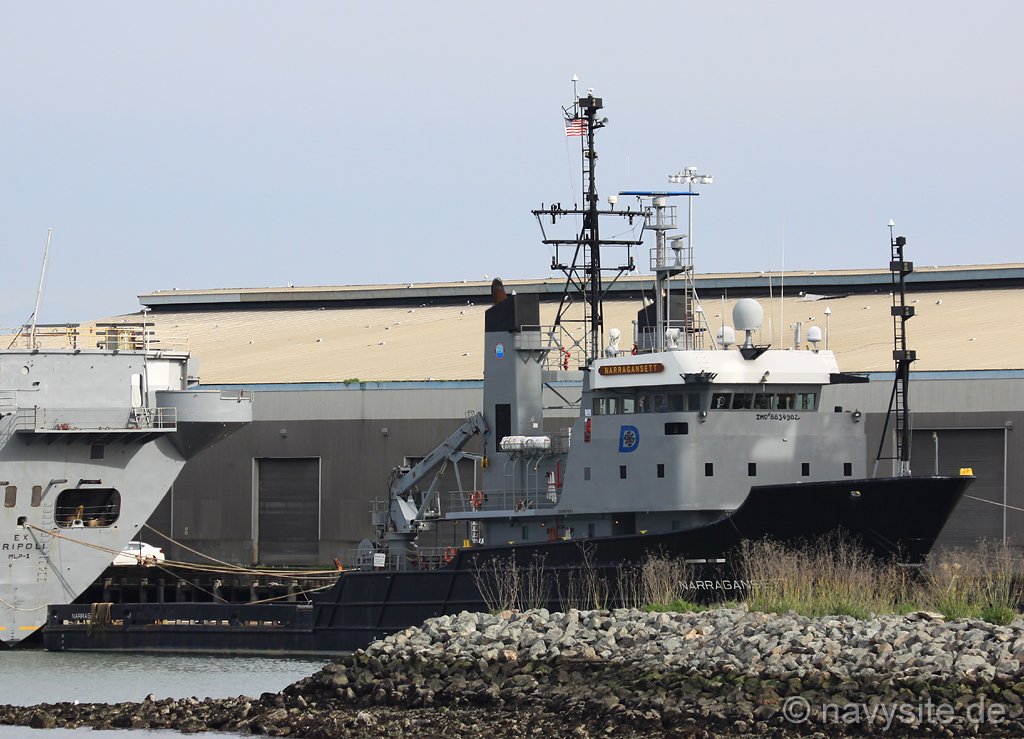
From 2002, NARRAGANSETT entered a distinct second career under Naval Air Systems Command sponsorship. Leased via industry partners and operated by DONJON MARINE, she became the dedicated tow platform for the former amphibious assault ship ex-TRIPOLI (LPH 10), which had been converted into a mobile sea-based target and missile-launch platform to support the Missile Defense Agency and Navy programs. Based variously at Pearl Harbor, at Mare Island (Vallejo), and then at Pier 80 in San Francisco, NARRAGANSETT towed ex-TRIPOLI to designated ocean operating areas - frequently off the Pacific Missile Range Facility, Kauai - to launch short- and medium-range surrogate targets for tests tied to THAAD development, the Navy's sea-based terminal ballistic-missile defense work, and cooperative Israeli ARROW campaigns. The ship's predictable deck layout, fuel endurance, and towing gear made her a staple of these multi-agency events through the early 2010s.
Concluding that period, on March 26, 2015, NARRAGANSETT towed ex-TRIPOLI through the Panama Canal for lay-up with the Beaumont Reserve Fleet, Texas, closing a long Pacific chapter for both vessels and freeing NARRAGANSETT for Atlantic duties.
By 2016, she had been reassigned to Carrier Strike Group FOUR's Training Support Vessel Squadron and re-marked locally as "TSV 4", operating from Joint Expeditionary Base Little Creek-Fort Story, Virginia. In that role, she shifted from blue-water to fleet training tasks, serving as a mobile sea range and exercise adversary for deploying Atlantic units. On July 3, 2016, and again on September 29, 2016, she acted as the compliant target vessel during visit, board, search, and seizure drills for USS MAHAN (DDG 72) as part of the GEORGE H. W. BUSH (CVN 77) Strike Group's pre-deployment work-up. In subsequent years she continued to support integrated exercises at sea - COMPTUEX, ARG-MEUEX, and tailored events - hosting force-protection, maritime interdiction, unmanned-systems, and live-fire events under CSG-4's live-virtual-constructive training architecture.
Sustained operations on the busy Hampton Roads range complex were punctuated by periodic shipyard maintenance. A docking phased maintenance availability in Norfolk was awarded in July 2017, funding hull preservation, machinery repairs, and habitability upgrades. Another docking availability was awarded in mid-June 2022, to Lyon Shipyard in Norfolk, with work planned through April 2023 to refresh hull, propulsion, and auxiliary systems for the training mission. Meanwhile, on April 12, 2021, the Navy awarded a five-year training-support contract to Great Eastern Group to crew, maintain, and operate the Training Support Vessel Squadron - including NARRAGANSETT - ensuring continuity of services under NAVSUP Fleet Logistics Center Norfolk.
As of 2024-2025, NARRAGANSETT remains in active Atlantic-coast training support, a veteran POWHATAN-class hull now deep into a third decade beyond her MSC towing prime.
back to top go to the end of the pageUSNS NARRAGANSETT Image Gallery:
The photo below was taken by me and shows the NARRAGANSETT at Naval Air Station North Island, San Diego, Calif., on March 10, 2008.
 |
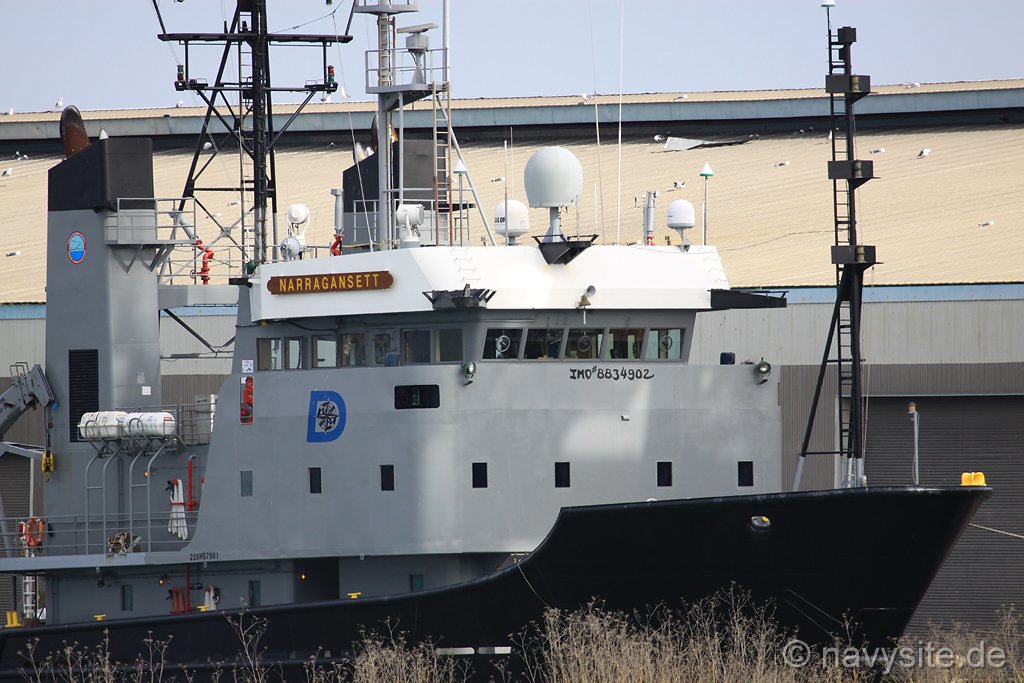
The photos below were taken by me and show the NARRAGANSETT at San Francisco, Calif., on March 19, 2012, serving as tow ship for the former USS TRIPOLI (LPH 10) which is used as a mobile launch platform as part of the Ballistic Missile Defense Program. The NARRAGANSETT is wearing the Missile Defense Agency badge on the stack.
 |  |
back to top Back to Fleet Ocean Tugs Page. Back to ships list. Back to selection page. Back to 1st page.