Search the Site with

|
Search the Site with
|
 General Characteristics Crew List Memorabilia In the News History Image Gallery to end of page


USNS SHASTA was the sixth ship in the KILAUEA - class of Ammunition Ships and the second ship in the Navy named after the extinct volcano in northern California. Decommissioned on 1 October 1997, SHASTA was transferred to the Military Sealift Command (MSC), Naval Fleet Auxiliary Force the same day and her hull number was changed to T-AE 33. SHASTA remained active as an ammunition ship until inactivated and stricken on April 7, 2011. She was subsequently laid up at Pearl Harbor, Hi., awaiting final disposal. In 2013, the former ammunition ship was taken under tow from Pearl Harbor to Brownsville, Texas, for dismantling.
| General Characteristics: | Awarded: March 8, 1968 |
| Keel laid: November 10, 1969 | |
| Launched: April 3, 1971 | |
| Commissioned: February 26, 1972 | |
| Decommissioned: October 1, 1997 | |
| MSC "in service": October 1, 1997 | |
| Inactivated: April 7, 2011 | |
| Builder: Ingalls Shipbuilding, Pascagoula, MS | |
| Propulsion system: 3 Foster-Wheeler boilers; 600 psi (42.3kg/cm²); 870°F (467°C); 1 turbine, 22,000 hp (16.4 MW); Automated Propulsion System (APS) | |
| Propellers: one (six bladed) | |
| Length: 564,3 feet (172 meters) | |
| Beam: 81 feet (24.7 meters) | |
| Draft: 28 feet (8.5 meters) | |
| Displacement: approx. 20,000 tons full load | |
| Speed: 20 knots | |
| Aircraft: two CH-46 helicopters | |
| Armament: none | |
| Crew: 125 civilians, 55 naval personnel (including a helicopter detachment) |
 back to top go to the end of the pageback to top go to the end of the page
Crew List:
This section contains the names of sailors who served aboard USS/USNS SHASTA. It is no official listing but contains the names of sailors who submitted their information.
back to top go to the end of the pageback to top go to the end of the pageUSNS SHASTA in the News:
back to top go to the end of the pageUSS/USNS SHASTA History:
USS SHASTA's keel was laid on November 10, 1969, at Pascagoula, Mississippi, by the Ingalls Shipbuilding Division of Litton Systems, Inc. She was launched on April 3, 1971, sponsored by Mrs. Mary G. Cousins, wife of Admiral Ralph W. Cousins, Vice Chief of Naval Operations, and was commissioned at Naval Base Charleston, South Carolina, on February 26, 1972, with Captain Warren C. Graham Jr. in command. Following commissioning, SHASTA carried out fitting-out work and began her shakedown period. Between May 22 and July 3, 1972, she moved from the Atlantic to the Pacific Fleet. During the voyage, she trained at Guantanamo Bay, Cuba, and visited Kingston, Jamaica; Cartagena, Colombia; Panama City in the Panama Canal Zone; and Acapulco, Mexico. After transiting the Panama Canal, she continued northward and ultimately arrived at her new home port at Naval Weapons Station Concord, California. Concord, situated in the San Francisco Bay area, was one of the Pacific Fleet's principal ammunition storage and loading facilities and remained closely associated with SHASTA throughout her commissioned career.
The remainder of 1972 was devoted to training, qualification and preparations for overseas service. SHASTA departed on her first western Pacific deployment on January 3, 1973. The deployment occurred during the final phase of direct American military involvement in Vietnam and only weeks before the Paris Peace Accords were signed on January 27. Her principal task became support for Operation End Sweep, the U.S. effort to clear or neutralize naval mines laid in North Vietnamese waters during 1972. Operation End Sweep required American minesweeping helicopters, surface support vessels and associated naval units to operate in and around previously mined waters, including the approaches to Haiphong. SHASTA did not conduct minesweeping herself but supplied ammunition and logistics support to the naval forces involved. Her underway-replenishment capability allowed supported ships to remain near the operating area rather than repeatedly returning to major logistics bases.
The deployment continued through the spring and early summer while the U.S. naval presence in Southeast Asia adjusted to the post-cease-fire environment. In addition to End Sweep support, SHASTA supplied other Seventh Fleet units operating in the western Pacific. She completed her first deployment on July 16, 1973, and returned to Pacific Fleet duties from California.
Her ammunition-support work resumed soon after the deployment. On October 10 and October 11, 1973, SHASTA conducted underway replenishment operations with USS KITTY HAWK (CV 63). Another replenishment with USS KITTY HAWK followed on November 1. SHASTA continued carrier-support operations during 1974. On April 19, she maneuvered into position to replenish USS ENTERPRISE (CVAN 65) while the carrier was underway. The evolution was documented by official Navy photography and represented the type of large-scale ammunition transfer that remained central to SHASTA's employment throughout her career.
During the middle years of the 1970s, SHASTA continued the recurring Pacific Fleet cycle of ammunition loading at West Coast facilities, fleet exercises, maintenance periods and western Pacific deployments. Aircraft carriers represented some of her largest customers, but cruisers, destroyers, frigates and amphibious ships also depended on ammunition ships for missiles, projectiles and other weapons.
A cruise book documents another extended SHASTA deployment during 1977. One incident during the deployment occurred while USS BUCHANAN (DDG 14) was replenishing from SHASTA during the westward transit. USS BUCHANAN lost power in its after engineering plant and had to execute an emergency breakaway. A span wire between the ships failed to release and SHASTA's deck crew cut the wire. The trailing cable subsequently became wrapped around USS BUCHANAN's port shaft. Divers were unable to free the shaft completely, and the destroyer diverted to Guam for repairs before rejoining its task force.
By the end of the 1970s, the geographic scope of Pacific Fleet logistics operations was increasingly extending beyond the western Pacific and into the Indian Ocean. Political instability in Iran, the seizure of the U.S. Embassy in Tehran in November 1979, the Soviet intervention in Afghanistan and the growing instability around the Persian Gulf resulted in American carrier groups being maintained farther west and for longer periods. The Pacific Fleet's ammunition ships consequently had to sustain forces operating thousands of miles from their West Coast bases.
An unusual domestic assignment followed the eruption of Mount St. Helens in Washington on May 18, 1980. SHASTA sailed to Portland, Oregon, from June 9 through June 21 to participate in the Portland Rose Festival while volcanic activity continued in the region. She entered the Columbia River at dawn on June 12 and embarked approximately 300 guests at Astoria. The ship then proceeded upriver through a channel that had been cut through debris associated with the eruption before mooring in downtown Portland. Continuing volcanic activity deposited additional ash aboard the ship and created a substantial cleaning task for the crew. SHASTA embarked another group of approximately 300 guests before beginning her downstream passage on June 16.
Later that year, on the evening of November 26, 1980, a fire broke out in the crew's lounge. The blaze damaged the lounge, an adjacent passageway and the flight-control tower directly above the affected compartment. Four sailors required temporary hospitalization. The fire was brought under control, and SHASTA subsequently returned to normal operations.
During the early 1980s, SHASTA continued Pacific Fleet deployments and increasingly supported carrier forces operating in the Indian Ocean and Arabian Sea. By late 1982, she was operating in the North Arabian Sea as part of a force centered on USS ENTERPRISE. The battle group included combatants and logistics ships required to sustain prolonged carrier operations far from permanent American naval bases.
On September 26, 1984, SHASTA collided with USS CLEVELAND (LPD 7) during a practice underway replenishment in the southern California operating area. USS CLEVELAND sustained small punctures in the port side of the hull above the waterline and approximately twenty feet of catwalk damage. Neither ship suffered serious casualties or damage severe enough to prevent continued operations. USS CLEVELAND returned to San Diego for temporary repairs before resuming refresher training.
SHASTA continued Pacific carrier-support operations through the middle of the decade. Her work required frequent practice because connected replenishment demanded precise shiphandling, communications and coordination between deck crews while two large vessels steamed close alongside one another. Vertical replenishment added another dimension, with embarked helicopters moving palletized ordnance between ships while flight-deck and cargo crews coordinated the transfer.
From January 24 through February 6, 1987, SHASTA operated with USS CARL VINSON (CVN 70) in the Gulf of Alaska and waters near the Aleutian Islands. Winter conditions exposed the ships to low temperatures, rough seas and poor weather, adding substantially to the difficulty of aviation and deck operations.
SHASTA began another major overseas deployment on July 14, 1987. The cruise took her through the western Pacific and Indian Ocean and into the Persian Gulf and continued until December 30. Commander Jeffrey A. Finley commanded the ship during the deployment. The strategic situation in the Persian Gulf was dominated by the Iran-Iraq War and repeated attacks on merchant shipping associated with the two belligerents' oil exports. The United States initiated Operation Earnest Will to protect reflagged Kuwaiti tankers and maintain freedom of navigation through the Gulf and Strait of Hormuz. Eleven Kuwaiti tankers were transferred to U.S. registry and escorted through the region by American naval forces. SHASTA formed part of the logistics network sustaining the ships performing those escort and security missions.
During the deployment, SHASTA embarked two Sea Knight helicopters from Helicopter Combat Support Squadron 11 Detachment 6. In addition to moving ammunition and other cargo, the helicopters performed logistics and emergency assignments and rescued four people during the cruise. SHASTA completed the western Pacific, Indian Ocean and Persian Gulf deployment on December 30, 1987.
After post-deployment maintenance and training she returned to normal Pacific Fleet support duties. Her work during this period continued to include exercises with other combat-logistics vessels, allowing crews to practice the shiphandling and cargo procedures required during actual deployments. On the morning of May 21, 1989, SHASTA collided with USS SACRAMENTO (AOE 1) during a replenishment evolution in the eastern Pacific. Both ships escaped serious damage, no casualties were reported, and they were able to complete their transfer operations later that day.
SHASTA began another overseas deployment on September 18, 1989. She followed a great-circle route across the North Pacific and encountered severe weather in the Gulf of Alaska and Aleutian region. A Sea Knight helicopter carried an advance detachment to Cold Bay, Alaska, and aviation support points were also established at Adak and Amchitka as operational requirements dictated.
October 3, 1989, was an especially active replenishment day. SHASTA conducted vertical replenishments with USS NEW JERSEY (BB 62), USS LAKE CHAMPLAIN (CG 57) and USS PELELIU (LHA 5). The three ships represented very different ammunition requirements, ranging from the weapons associated with a battleship and guided-missile cruiser to the aviation and amphibious-force ordnance carried aboard an amphibious assault ship.
While SHASTA was west of the International Date Line, the Loma Prieta earthquake struck the San Francisco Bay region on October 17, 1989. Because of her position, the ship received the news on October 18. Many crew members had relatives and friends in the affected area, and shipboard personnel worked to obtain information from California and confirm the safety of their families. SHASTA continued the deployment and returned to the United States on December 16.
Less than a year later, Iraq's invasion of Kuwait on August 2, 1990, produced another major expansion of American naval operations in Southwest Asia. SHASTA departed on December 8, 1990, for a deployment that took her through the western Pacific and Indian Ocean into the Persian Gulf. She served there during Operations Desert Shield and Desert Storm and remained overseas until June 8, 1991. Coalition combat operations against Iraq began on January 17, 1991. Aircraft carriers in the Red Sea and Persian Gulf conducted intensive strike operations, while cruisers, destroyers and other warships carried out air-defense, maritime-interception and missile missions. Ammunition ships such as SHASTA formed an important part of the afloat logistics system required to replace aviation weapons, missiles and other ordnance expended during the campaign.
At 2245 on January 20, USS LEYTE GULF (CG 55), operating approximately fifty miles northwest of the main battle-group formation, detected what appeared to be a chemical-agent cloud drifting toward the ships. SHASTA sounded general quarters, and the crew donned protective masks in preparation for a possible chemical attack. The suspected cloud was subsequently determined not to present the feared chemical threat, and the alert was cancelled.
SHASTA entered Mina Salman, Bahrain, from February 25 through February 27. Crew members going ashore during their limited liberty carried protective masks because of the continuing possibility of Iraqi ballistic-missile attacks. Shortly after the liberty period began, another alert was sounded following a report that an Iraqi Scud missile might be approaching the area. That warning also proved erroneous.
The coalition cease-fire on February 28 ended the main combat phase of the Gulf War, but SHASTA's regional duties continued. Naval forces still required ammunition, supplies and support while conducting maritime interception, minesweeping, air-defense and postwar operations.
On March 29, 1991, SHASTA became involved in a major civilian maritime emergency. The Sri Lankan merchant ship MERCS HORANA caught fire in the central Persian Gulf. SHASTA was approximately twenty miles away when the emergency was reported and immediately reversed course toward the casualty. One of SHASTA's Sea Knight helicopters delivered two large containers of firefighting equipment to USS FRANCIS HAMMOND (FF 1067), which, together with the British frigate HMS BRILLIANT (F 90), reached MERCS HORANA before SHASTA. By the time SHASTA arrived approximately one hour later, flames had spread through much of the merchant ship's superstructure.
SHASTA organized four firefighting teams comprising approximately seventy sailors and sent personnel and equipment across in two 33-foot boats. The boats repeatedly shuttled between the ships throughout the night. Four women from SHASTA participated in the first two firefighting parties sent aboard the merchant vessel. USS NIAGARA FALLS (AFS 3) and the Spanish frigate VICTORIA (F 82) later joined the multinational effort. HMS BRILLIANT primarily attacked the fire from the starboard side while VICTORIA worked from the port side. The firefighting operation continued for almost twenty-four hours before HMS BRILLIANT took MERCS HORANA under tow to prevent the damaged vessel from becoming a navigation hazard.
SHASTA subsequently began the return voyage to the Pacific and completed the overall deployment on June 8, 1991. Following her return, SHASTA entered another period of maintenance and training. From May 11 through May 22, 1992, she worked with USS KANSAS CITY (AOR 3) during in-port and underway replenishment training. The training fully qualified USS KANSAS CITY for its replenishment mission and provided both ships with practice in the procedures required during later deployments.
During 1993, SHASTA deployed again to Southwest Asia as part of the logistics force supporting the carrier group centered on USS NIMITZ (CVN 68) and American operations connected with Iraq. The United States continued enforcing United Nations sanctions and Operation Southern Watch, which restricted Iraqi military aviation over southern Iraq. USS KANSAS CITY served as the Afloat Logistics Coordinator for U.S. surface forces in the Central Command area and managed the employment of regional supply ships, including SHASTA, USNS PECOS (T-AO 197), USNS WALTER S. DIEHL (T-AO 193) and USNS SPICA (T-AFS 9). The arrangement allowed the logistics force to coordinate fuel, ammunition and stores deliveries between the Persian Gulf, Gulf of Oman and Arabian Sea.
On May 24, 1993, USS DE WERT (FFG 45) replenished from SHASTA in the Gulf of Oman after completing Exercise Saqr Al Bahr with the Omani Navy. USS DE WERT then proceeded through the Strait of Hormuz toward a port visit at Dubai.
During the summer of 1994, SHASTA conducted one of the largest documented ammunition transfers of her later commissioned career. During a three-day pre-deployment evolution, USS ABRAHAM LINCOLN (CVN 72) received more than 2,400 tons of ordnance from SHASTA in more than 1,300 vertical-replenishment lifts. At the conclusion of the operation, USS ABRAHAM LINCOLN's ammunition allowance had been raised to approximately ninety percent of its planned shipfill, preparing the carrier for its forthcoming overseas deployment.
SHASTA continued supporting Pacific Fleet workups during 1995. As USS FORD (FFG 54) trained for a deployment with the USS NIMITZ battle group, the frigate's Visit, Board, Search and Seizure team conducted several practice boardings against SHASTA in preparation for anticipated maritime-interception operations.
USS NIMITZ deployed to the western Pacific and Middle East late in 1995. Ships associated with the force at various times included USS PORT ROYAL (CG 73), USS CALLAGHAN (DDG 994), USS OLDENDORF (DD 972), USS FORD, USS PORTSMOUTH (SSN 707), USS WILLAMETTE (AO 180), USS BIRMINGHAM (SSN 695) and SHASTA.
On January 14, 1996, SHASTA transited the Strait of Hormuz in company with USS CALLAGHAN and USNS SPICA. The deployed naval force was supporting Operation Southern Watch and continuing maritime-security and sanctions-enforcement operations connected with Iraq.
SHASTA remained an active commissioned ammunition ship through 1996 and 1997, but the Navy was progressively transferring the aging KILAUEA-class vessels to Military Sealift Command. Civilian operation allowed the Navy to retain their logistics capability with a different manning structure while newer logistics ships were being planned and introduced. On October 1, 1997, USS SHASTA was decommissioned at the Fleet and Industrial Supply Center Oakland, California. On the same day, she was placed in service with Military Sealift Command as USNS SHASTA (T-AE 33) and assigned to the Naval Fleet Auxiliary Force.
Under Military Sealift Command, civilian mariners assumed responsibility for navigation, engineering and most routine operation of the vessel. A smaller Navy military department remained aboard for functions requiring military personnel. Although the administrative and manning arrangements changed, the ship's basic purpose did not: she continued carrying ammunition to deployed naval forces and transferring it by connected or vertical replenishment.
During the late 1990s and early years of the twenty-first century, USNS SHASTA continued operating with Pacific and Indian Ocean naval forces. Unlike some older auxiliaries that spent extended periods in reserve status, SHASTA remained an active logistics ship.
<
On March 30, 2002, the merchant vessel CAPE HORN suffered a serious engine-room fire. Two of the civilian vessel's crew members died from smoke inhalation after entering the affected machinery space. USNS SHASTA responded to the emergency and provided drinking water, firefighting equipment and towing tools. SHASTA personnel also assisted in rigging a tow and received the two deceased mariners from CAPE HORN. The incident added another maritime-assistance mission to SHASTA's long record of operations outside her normal ammunition role.
During 2003, SHASTA operated in the logistics system supporting Operations Enduring Freedom and Iraqi Freedom. Helicopter Combat Support Squadron 4 records identify USNS SHASTA among the ships supported by the logistics organization operating from Fujairah, United Arab Emirates, during the first half of that year. On May 2, 2003, while transiting the Indian Ocean, SHASTA encountered a stranded Sri Lankan fishing boat whose six-man crew required assistance. SHASTA launched a rigid-hulled inflatable boat and provided the fishermen with more than 100 gallons of diesel fuel and a bag of rice. The fishermen in turn gave the SHASTA crew several yellowfin tuna from their catch. At the time, the ammunition ship carried approximately 134 civilian mariners and seven active-duty Navy personnel and had recently supported Operation Iraqi Freedom.
During May 2004, ammunition responsibilities within the Seventh Fleet logistics force were reorganized as USNS FLINT (T-AE 32) prepared to leave the area after an unusually long deployment. During a concentrated five-day period, USNS FLINT transferred nearly 4,000 ordnance loads to USNS KISKA (T-AE 35) while receiving almost 1,500 loads from SHASTA. The successive cross-deck evolutions redistributed the ammunition inventories among the ships as their Seventh Fleet assignments changed.
On September 5, 2004, SHASTA transferred ammunition to USS KITTY HAWK in the Pacific. Heavy seas caused the ammunition ship to pitch through substantial swells while the replenishment continued, illustrating the conditions under which logistics evolutions sometimes had to be performed.
SHASTA, USNS FLINT and USNS KISKA were again operating together in the Sea of Japan on November 11, 2005. The three KILAUEA-class ammunition ships had completed a cross-deck evolution involving approximately 1,500 pallets of ordnance. Their simultaneous presence demonstrated that, more than three decades after the class had entered service, the ships still formed an important element of Seventh Fleet ammunition logistics.
SHASTA remained active as newer LEWIS AND CLARK-class dry cargo/ammunition ships gradually entered the fleet. The newer T-AKE vessels combined ammunition and dry-stores capabilities that previously required several specialized classes, but the replacement process extended over a number of years. On October 31, 2007, SHASTA replenished USS KITTY HAWK with ammunition in the Pacific during operations associated with the carrier's late-year deployment. An MH-60S Seahawk from Helicopter Sea Combat Squadron 25 moved loads from SHASTA to the carrier's flight deck.
The relationship continued during the following year. On March 5, 2008, an MH-60S Seahawk from the same squadron again transferred ammunition from SHASTA to USS KITTY HAWK while the carrier was conducting sea trials.
By the end of the decade, the Navy was completing the transition from the specialized KILAUEA-class ammunition ships to the LEWIS AND CLARK-class dry cargo/ammunition ships. Fiscal planning for the following years therefore included the retirement of the remaining T-AE vessels. USNS SHASTA was placed out of service on April 7, 2011, ending thirty-nine years of active Navy and Military Sealift Command service. Her military department was disestablished as part of the deactivation process, and the ship was transferred to reserve status. She was subsequently towed to the Naval Sea Systems Command inactive-ship facility at Joint Base Pearl Harbor-Hickam, Hawaii, while awaiting disposal.
A Navy historical evaluation completed during 2012 determined that SHASTA did not meet the criteria requiring preservation as a historic vessel. Disposal therefore proceeded. In 2013, the former ammunition ship was taken under tow from Pearl Harbor to Brownsville, Texas, for dismantling.
back to top go to the end of the pageUSS/USNS SHASTA Image Gallery:
 |  |
The photo below was taken by Karl-Heinz Ahles and shows USNS SHASTA at Portsmouth, Va., on March 11, 1999.
 |
The photos below were taken by me and show the USNS SHASTA departing San Diego, Calif., on March 23, 2010.
 |  |  |  |  |
 |  |
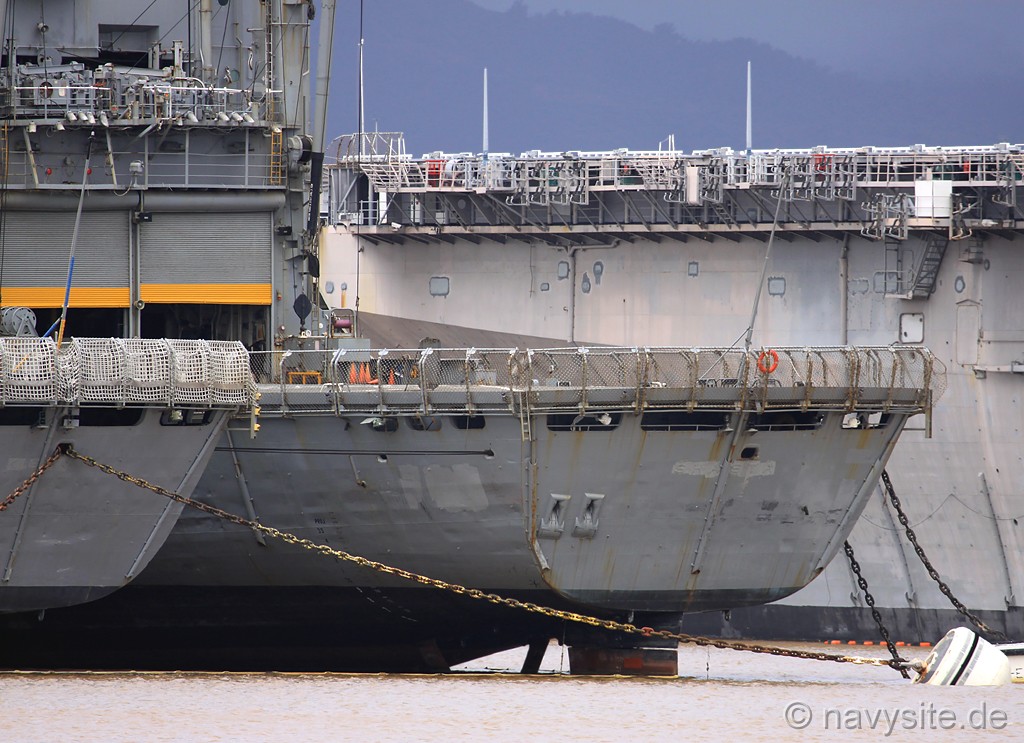
The photos below were taken by me and show the SHASTA laid up at Pearl Harbor, Hi., on March 6, 2012. There, the SHASTA (right) is laid up alongside her sistership KISKA (T-AE 35)[center].
 |  |
back to top Back to Ammunition Ships Site. Back to ships list. Back to selection page. Back to 1st page.